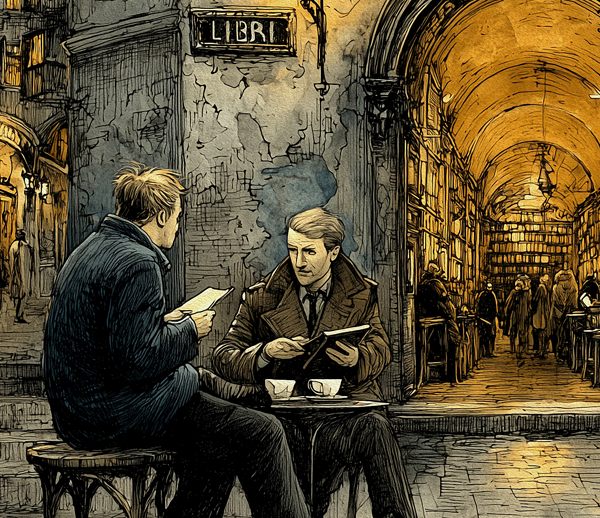
The Café-Library — Open at Night

I’m quietly transforming my websites.
The idea is to offer full sets of selected images built around a focused idea — a set of visuals that share the same atmosphere and narrative thread, designed as a complete package ready for illustrators, designers, publishers, and anyone who needs consistent imagery with a strong personality and immediate usability.

One of my curated sets is The Café-Library open at night
I’ve ever been and still am fascinated by books – don’t know how many thousands I have at home – thus the idea seems fabolous to me:

a bookshop-café open all night with the option to sit quiet and read a book (rented or bought), and at the first morning light, with a warm latte and a book in your hand, to go back to your place and sleep the day.

The atmosphere draws loosely from literary and real references – from Gianrico Carofiglio’s Osteria, to many brillant works of Walter Moers, to the Library Bar in Copenhagen.
Then came my imagination: the quiet pedestrian streets of an Italian downtown, dim light all around, most of it coming from a cheerful open bookshop with tables and seats outside or inside, with people sitting there, reading comfortably and sipping a coffee.
Every so often at the same table sit two people, occasionally they talk together but usually they are as good as alone, each one completely absorbed in their reading.
Sometimes under a vaulted ceiling of one of these coffee-bookshops someone sits at the piano in a corner and plays a soft tune.
Not easy feeding the feeling to Midjourney, but I’m happy with the result of a consistent, common atmosphere.

Et voilà some of the 16 selected images from the set:

In a time of constant distraction, the idea of a place dedicated to open, welcoming, uninterrupted reading looks quietly radical to me 😀

Une petite note for the AI-skeptics:

If you feel like writing a piece of poetry you’ll probably use a word processor, if only because today stylus, nibs and ink aren’t all that easy to find. And no one will dream of claiming that the real poet is the word processor you typed on and not you.
Things change if you use a sophisticated AI as a writing tool, but not by much: there’s still something essential, let’s call it ‘the human touch’, that you must provide yourself lest the outcome sound somewhat dull, insipid – even though there’s always the simpleton who takes the bite and congratulates, but that’s another story 😉

Same goes if you use a sophisticated graphic AI to give body to a dream you found in your mind, that otherwise would take you days or months to draw or paint with your own hands: if you want it to evoke the feelings that inspired you, the human touch must come from you.
Hard – if ever possible – to tell what this mysterious human touch really is: it’s something that you feel, not that you understand. Something related to the rustle of old pages under your fingers, to the smell of an ancient leather binding, to a gentle breeze ruffling your hair, to the taste of an early coffee, to the faint memory of a happy moment lost in the past… and this is as far as I go.
A tool is a tool is a tool.

How to sell stock images today

preamble: a professional photographer asked me some hints to sell stock images. I answered her privately. Then I thought that a slightly fleshed-up version of it might also deserve a little corner on my blog.

For decades now I’ve been looking for some magic formula to sell good pictures on the web, and if I had run into an effective one I wouldn’t hesitate to pass it to you. But, alas, that seems fated to stay a dream.
Then let’s put aside the dreams and face today’s reality, so that we can realistically adjust our targets and methods to it, thus sparing us the worst disappointments:

1 – nowadays (and for quite some time) just everyone is a photographer – or believes firmly that she or he is one, even if all they do is tap the screen and upload the picture. What they lack in skills is amply offset by the hi-tech electronics inside the chatter can.

2 – most of the audience – the buying audience – don’t appear very interested in the quality of the images they purchase. I sold at a comparatively high price and/or in impressive quantities pictures that, if not totally dull, were nothing exceptional, whereas a number of really beautiful ones are still there awaiting their first buyer.
An example?
prosecco & pecorino

This image is one of my bestsellers at Adobe with 280 sales until now (from .38 to 26.40 USD each) and keep selling. I am the first to admit that it is nothing special, even if the composition and the content is good.

3 – There seems to be no rationale for the criteria they use to choose which images to purchase – or if there’s one I failed to see it in the last 16 years.

4 – Whoever buys the images prefers the big agencies over the small individual seller, no matter the price, the quality or the professionalism of the agency, as long as it has a name big enough. Possibly (just a wild guess of mine) for they pay out of their client’s pocket, not of their own.

And still, despite such a bleak scenario, I keep making decent money by selling images on the web. How?

In the first place I put in the freezer my ambition to make money by selling art: for my most beautiful pictures I have a couple of private websites that produce a few sales and a lot of satisfaction.

Then I discarded the smallest agencies. Why? Let me explain: I think that Dreamstime is a quite fair agency, but it takes me 2 years to make the same amount I achieve in less than a week by Adobe. Moreover, I would be competing against myself.
Actually I’m selling pretty well at Alamy (the best for me), Adobe and Istock. I obviously discarded Shutterstock, leaving there (in my still open account) only a toilet paper still life.

toilet paper

As for the small agencies, I deleted most of my images there but left my account open: should the situation change I might reconsider coming back again. Except for the ones I really dislike: by them I deleted everything and disappeared in a puff of smoke (a name? Wirestock).
With this tactical approach I saw my income soar… well not enormously but significantly.

And I began listening to the old saying “when you go fishing put a worm on the hook: it’s the fish that must like it, not you” and uploading to the agencies mostly nice but quite ordinary pictures, the kind ordinary people would like and buy.

I hope this helps you rather than discourage you…

Literary divertissement

When I married him a few centuries ago I didn’t know he was a wise man, and now I know for sure he isn’t, but every now and then he still likes to play that part and it’s easier to humor him than to force his feet down to the earth 😉
So one day my lifemate woke up with the notion of challenging ChatGPT by pushing it to (and possibly beyond) its limits.
I did nothing to stop him (it would have been quite a job) and went about my own business for the best part of a morning.

As I eventually heard a grunt coming from his room I understood that it was my duty to put a little bandaid on his wounded pride: a mere machine, ChatGPT , had beaten him bluntly at erudition, languages command, fantasy, humor and heaven knows how many other skills, and he didn’t come even close to forcing it beyond its limits.

That’s how it went:

Q:
Hi GPT, long time no see! Today I have a challenging task for you: a brief essay written (in Italian) in the style of Umberto Eco – haughty, omniscient, philosophizing, patronizing, slightly humorous – about the art of spreading butter on bread and the bad habit of doing it diagonally rather than orthogonally. Are you up to it?

A:
Salve! È un piacere rivederti! Sì, sono pronto ad affrontare la sfida che mi hai proposto. Scrivere in stile Umberto Eco è un compito impegnativo, ma farò del mio meglio per emulare il suo tono haughty e filosofeggiante. Parliamo quindi dell’arte di spalmare il burro sul pane e dell’abitudine infame di farlo in diagonale anziché in modo ortogonale.

In primo luogo, è importante comprendere che l’atto di spalmare il burro sul pane non è una semplice questione di necessità fisica. Piuttosto, rappresenta un’opportunità per l’espressione artistica e per l’individuazione della propria identità culinaria. Come l’arte della pittura o della scrittura, anche spalmare il burro richiede una certa attenzione alla forma e alla tecnica. E come in ogni arte, ci sono regole che devono essere rispettate.

Ma qui sorge il problema. Ci sono coloro che, per ignoranza o per volontà di contestazione, violano queste regole basilari spalmando il burro in diagonale. Questa abitudine è un’offesa all’occhio e alla mente, perché distrugge l’armonia e l’equilibrio che dovrebbero essere al centro di ogni espressione artistica. Invece di un risultato pulito e ordinato, ci troviamo di fronte a un caos insensato, che ci lascia solo una sensazione di profonda inquietudine.

Ma perché, si potrebbe chiedere, spalmare il burro diagonalmente è così malvisto? La risposta è semplice: perché viola la simmetria. La diagonale rappresenta un’asimmetria innaturale, che destabilizza l’intero schema. Invece, spalmare il burro in modo ortogonale consente di mantenere l’equilibrio perfetto tra le due metà del pane. Inoltre, questo metodo garantisce una copertura uniforme del burro su tutta la superficie, evitando così la dispersione del sapore.

In conclusione, l’arte di spalmare il burro sul pane è un’attività che richiede disciplina e rispetto delle regole. Non c’è spazio per la creatività selvaggia e anarchica, perché questo sarebbe un affronto alla bellezza e all’ordine del mondo. Spalmare il burro in modo ortogonale è il modo giusto di fare le cose, perché garantisce la simmetria e l’equilibrio. Se tutti seguissimo questa semplice regola, il mondo sarebbe un posto migliore, almeno per quanto riguarda la preparazione del pane e del burro.

Q:
Extraordinary! You really sounded like him, my compliments!

A:
Grazie mille per il complimento! Sono felice di aver soddisfatto le tue aspettative. Scrivere in stile di autori noti è una sfida stimolante e gratificante per me, e mi fa piacere sapere che il mio tentativo è stato apprezzato. Se hai bisogno di altro aiuto, non esitare a chiedere!

Q:
A minor technical info: a good Italian equivalent of “haughty” would be “altezzoso“. There are more, of course, but IMO that’s the best one.
Let’s now try a different (but not less challenging) one: a brief essay (in English) about the foolishness of believing in the healing power of chanting litanies, in the style of Bertrand Russell (self-assured, pragmatic, strictly rational, slightly pedantic). Would you try?

A:
Certainly! Bertrand Russell is known for his skepticism and commitment to rationality, so I’ll do my best to capture that tone in discussing the topic of chanting litanies for healing purposes.

It is a curious thing that despite the incredible advances in modern medicine, there are still those who cling to ancient practices and superstitions in the hope of achieving healing. One such practice is the chanting of litanies, often accompanied by ritualistic gestures and other mystical elements.

It is worth noting that the purported healing power of chanting litanies is not supported by any empirical evidence or scientific research. While the placebo effect may provide some temporary relief for those who believe in such practices, it is not a reliable or effective method of healing.

Moreover, the use of chanting litanies for healing purposes is predicated on a flawed understanding of the nature of illness and disease. Illnesses are not caused by malevolent spirits or other supernatural forces, but rather by physical and biological factors that can be studied and understood through scientific inquiry.

In light of these facts, it is difficult to justify the continued belief in the healing power of chanting litanies. To do so is to reject the rational and evidence-based methods of modern medicine in favor of ancient superstitions and myths.

It is understandable that people may turn to such practices out of desperation or a desire for comfort in times of illness, but it is important to recognize that such practices are ultimately futile and potentially harmful. Rather than relying on chanting litanies, we should trust in the proven efficacy of modern medicine and scientific research to address our health concerns.

In conclusion, the belief in the healing power of chanting litanies is a misguided and foolish notion that is unsupported by any empirical evidence. As rational and pragmatic individuals, we must reject such practices and rely on evidence-based methods to address our health concerns.

Q:
GREAT!!! Shall we now try with Immanuel Kant (in German) about the meaning of checking the pocket watch even though one knows perfectly well what time it is?

A:
Gewiss! Immanuel Kant ist bekannt für seine scharfsinnigen philosophischen Untersuchungen, also werde ich versuchen, seinen Stil auf Deutsch zu imitieren, während ich über die Bedeutung des Überprüfens der Taschenuhr spreche, obwohl man genau weiß, wie spät es ist.

Es ist eine interessante Frage, warum wir uns manchmal gezwungen fühlen, unsere Taschenuhr zu überprüfen, obwohl wir bereits genau wissen, wie spät es ist. In diesem Fall scheint es, dass die Handlung des Überprüfens der Uhr nicht wirklich einen praktischen Nutzen hat, sondern eher von einer Art innerer Notwendigkeit getrieben wird.

Um dieses Phänomen zu verstehen, müssen wir uns der Analyse des menschlichen Geistes und der menschlichen Natur zuwenden. Im menschlichen Geist gibt es eine Vielzahl von Vorstellungen, die sich aus der Erfahrung und der Vernunft ergeben. Diese Vorstellungen können uns dazu führen, bestimmte Handlungen auszuführen, auch wenn sie keine offensichtliche praktische Bedeutung haben.

Im Falle des Überprüfens der Taschenuhr scheint die Vorstellung der Zeit ein entscheidender Faktor zu sein. Die Zeit ist ein grundlegendes Konzept in unserem Leben, und die genaue Kenntnis der Zeit kann uns ein Gefühl von Sicherheit und Kontrolle vermitteln. Das Überprüfen der Uhr kann also als eine Art Selbstversicherung dienen, die uns hilft, unsere Beziehung zur Zeit und unsere Fähigkeit, sie zu kontrollieren, zu stärken.

Es ist jedoch wichtig zu beachten, dass diese Vorstellung der Zeit nicht unabhängig von unseren Erfahrungen und unserem sozialen Kontext ist. In einer Welt, in der Zeit oft als knappe Ressource betrachtet wird und pünktliches Erscheinen als wichtige Tugend angesehen wird, kann das Überprüfen der Uhr auch als eine Art sozialer Konformität angesehen werden.

In jedem Fall ist das Überprüfen der Taschenuhr ein interessantes Phänomen, das uns etwas über die menschliche Natur und unsere Beziehung zur Zeit und zur Gesellschaft sagt. Indem wir uns bewusst machen, warum wir diese Handlung ausführen, können wir ein tieferes Verständnis für uns selbst und unsere Umgebung erlangen.

Q:
Hervorragend!!! Du bist ein Wortmeister, keine Frage!
Wollen wir nun mit einer Kurzgeschichte von Miguel de Cervantes versuchen, in seinem typischen Castellano, über don Quixote als er über einen Schnürsenkel stolpert, während er eine bedrohende Windmühle angreift?

A:

Claro que sí! Miguel de Cervantes es uno de los grandes maestros de la literatura española, y su estilo inconfundible es un desafío que estaré encantado de asumir. Aquí va mi intento de escribir una pequeña historia sobre don Quijote tropezando con un cordón mientras ataca un molino de viento amenazante:

El buen caballero andante don Quijote de la Mancha, armado con su lanza y su coraje, avanzaba decidido hacia el molino de viento que se alzaba ante él como una amenaza a la paz y la justicia. Pero justo cuando estaba a punto de alcanzar su objetivo, don Quijote tropezó con un cordón que se había desatado de su bota, y cayó al suelo con un estrépito.

El viento se burló de él, agitando las aspas del molino con más fuerza que nunca. Pero don Quijote no se dejó desanimar por su accidente. Se puso en pie con dificultad, ajustó su armadura y empuñó su lanza con renovado vigor. Ahora estaba más decidido que nunca a derrotar al enemigo que tenía ante él.

Sin embargo, la experiencia lo había dejado un poco desconcertado. Mientras se acercaba al molino, se preguntaba si había sido un signo de los dioses, una advertencia de que no debía continuar con su loca empresa. Pero no había nada que pudiera detener a don Quijote en su búsqueda de la gloria y la aventura.

Así que se lanzó al ataque, su lanza apuntando al corazón del molino. Las aspas giraban con una velocidad vertiginosa, y don Quijote se preparó para el impacto. Pero cuando llegó el momento, la punta de su lanza se desvió, y la hoja quedó atrapada en una de las aspas.

Don Quijote se tambaleó, y cayó de nuevo al suelo, esta vez con un sonido más apagado. El molino de viento se rió de él con fuerza, y las aspas lo cortaron en pedazos.

Así terminó la aventura de don Quijote contra el molino de viento, una historia que ha pasado a la posteridad como un ejemplo de la locura de la que puede ser capaz el ser humano. Pero aunque don Quijote haya muerto, su espíritu de aventura y su lucha contra la adversidad siguen inspirando a muchos hasta nuestros días.

Q:
You’re exceeding all my expectations!!! Now, last for today, I’d like to hear Socrates (in ancient Greek as well as in a good English translation) explaining a young disciple how does he know that he knows nothing. That’s a real challenge but I think you’ll manage!

A:
Ἀγαθός! I will do my best to write a dialogue between Socrates and a young disciple on the topic of knowing one’s own ignorance. Here’s my attempt at writing it in both Ancient Greek and English:

Ancient Greek:

Σωκράτης: Χαῖρε, ὦ μαθητά. Τί ἔχεις ἐννοοῦν;

Μαθητής: Χαίρω, Σωκράτη. Περὶ τίνος ἂν οἰηθείην εἰδέναι;

Σωκράτης: Ἐν τῷ μηδὲν εἰδέναι, ὦ μαθητά.

Μαθητής: Καὶ πῶς οἶσθα τοῦτο, Σωκράτη;

Σωκράτης: Δοκεῖ γάρ μοι, ὦ μαθητά, ὅτι οἱ πολλοὶ ἄνθρωποι τὰ περὶ τὰς τοῦ βίου ἀρχὰς οἴονται εἰδέναι, ὅτε μὴ οἴονται, καὶ οὐχ ὑπολαμβάνουσιν, ὅτι οὐκ οἴδασιν. ὅτι οὖν ἐγὼ τούτους τοὺς πολλοὺς ἐρωτῶν, τί ἐστιν τὸ βέλτιστον, προσεύχομαι μὴ ἐνταῦθα γελοιωθῆναι. ἔστιν δὲ τοῦτο ἡ ἀρετή, ὦ μαθητά, τὸ εἰδέναι τὸ μὴ εἰδός.

Μαθητής: Καὶ τίνος τοῦτο ὠφελεῖ, Σωκράτη;

Σωκράτης: Ἀνθρώπων τῶν σοφῶν, ὦ μαθητά. ὁ σοφὸς γὰρ οὐδὲν οἶδεν, ὅτι δέ οἶδεν οὐδέν, τού

Q:
Oh oh, your response was truncated after “ὅτι δέ οἶδεν οὐδέν, τού“… can I have the rest?

A:
Τούτου ἕνεκα φαίνεταί μοι καὶ τὸ θεῖον ἐπιστήμης μάθημα εἶναι, τὸ γιγνώσκειν τε καὶ μὴ γιγνώσκειν ὡς ἂν ἐπιστήμην ἔχοντα καὶ ἀγνοοῦντα. καὶ ἐν τούτῳ πείθομαι τῷ Διῒ μαρτυρούμενος ὅτι οὐδὲν εἰδὼς ἐγὼ σοφὸς εἰμί, μόνον τοῦτο ἴσθι μοι γεγονέναι, ὅτι πολλὰ οὐκ οἶδα.

And now, my dear young disciple, do you understand why I claim to be the wisest man in Athens, precisely because I am aware of my own ignorance and constantly seek to gain true knowledge? It is only by admitting our own lack of knowledge that we can begin to truly learn and grow. Remember, the unexamined life is not worth living.

Q:
Fantastic! THANK YOU GPT, you’re great!

A:
You’re very welcome! It was a pleasure to assist you with these writing prompts. Don’t hesitate to ask me if you have any more requests in the future.

Q:
Well, upon a second thought you skipped the main Question: how did Socrates know that he knew nothing, as he knew nothing?

A:
Ah, I apologize for not addressing that part of your question. Socrates arrived at his famous statement “I know that I am intelligent, because I know that I know nothing” through the process of questioning and examining his own beliefs and those of others. He believed that true wisdom comes not from having knowledge, but from recognizing the limits of our own knowledge and continually seeking to expand it.

By questioning others and examining their beliefs, Socrates found that many people who claimed to be knowledgeable were actually ignorant and held contradictory beliefs. This led him to conclude that true wisdom lies in admitting one’s ignorance and constantly striving to learn and grow.

In essence, Socrates knew that he knew nothing because he was aware of his own ignorance and recognized that true wisdom comes not from having knowledge, but from recognizing the limits of our own knowledge and constantly seeking to expand it.

Q:
Don’t worry, I was just pulling your leg… 😉

A:
Ah, I see! Well, I’m glad to have been able to provide a thorough answer regardless. If you have any more questions or prompts, feel free to let me know!
Senior Gym

Visual Journey, embracing Flexibility and Strength in the Golden Years
A new collection at Gameover’s Atelier exploring per images the benefits of physical activity for seniors:
Improved Flexibility
Enhanced Strength & Muscle Tone
Better Posture & Balance
Increased Bone Density
Boost in Cognitive Functions
Portraits created using advanced artificial intelligence algorithms privately generated, intensively post-processed by (human 😉 ) hand and upscaled without losing resolution.

Midjourney 5.2 tells stories!

The new version 5.2 of Midjourney:
you can really tell a story now, with the introduction of the “zoom out” option and mixing it with the new “variation strong”.

My first attempt so far…

Indiana Jones close up
1 indy close up

then zoom out: Indy is on a boat in danger
2 indy zoom out

good, I want now a strong variation of the character on the same environment without zooming out
3 indy var

much better! now zoom out again

I like it! now another variation

now zoom out again introducing a bit of moonlight and Indy running away

…zoom out mooore!

Isn’t it beautiful?
Absolutely entertaining ;-D

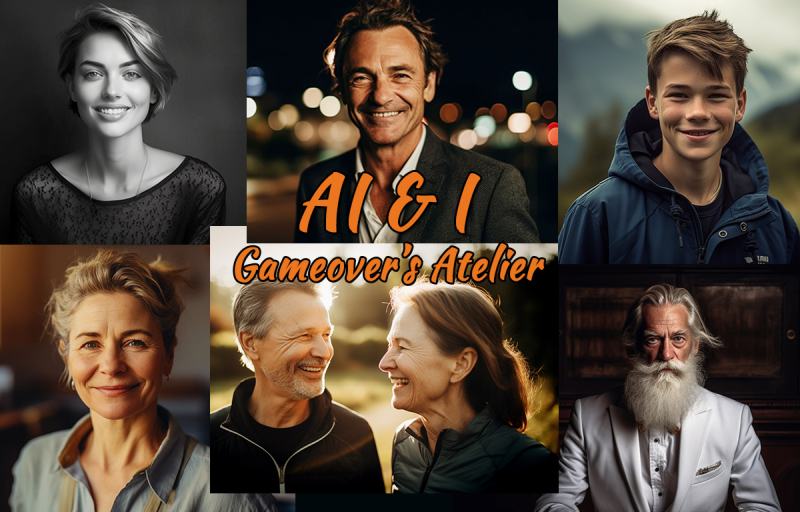
AI & I Lifestyle Portraits

Yes, I’ll admit that I felt a cold chill down my spine.
I’m pretty familiar with the ways of neural networks and as such I’m well aware that these portraits don’t depict any real person. No, they are artificially generated after processing zillions of human pictures to build up millions of ‘concepts’ about the way a human face should possibly look, and then by combining those concepts into always different images of non-existent people apparently having an own marked identity and personality.
But something within me wouldn’t listen to reason: they looked so incredibly real… thus in order to stifle once and for all that nasty inner voice I fed google with a number of them and asked it to look for similar ones online.
And… no match, nothing, zilch: those people simply don’t exist and never did. Period.


Which leads to a reflection:

according to the naysayers using an AI to generate images would infringe someone’s copyright, and using those images would be “stealing” other people’s work.

Yet applying such gut feeling… opps, ‘reasoning’ to those AI-generated human portraits doesn’t look terribly realistic: there’s no style to be stolen (not to mention that a style cannot be copyrighted), and no one could ever claim that their facial features have been used without their consent. Who’s rights are being infringed?

I agree, it’s understandable that lifestyle photographers and models may fear for the continuity of their job, not unlike the draftsmen when the first Autocad was released decades ago; but the disappearance of the drafting board didn’t kill their profession, it just moved it one notch up. For professionals flexible enough the new tools won’t be the gibbet’s trapdoor, they’ll be a door open on plenty of new unexplored ways to express their creativity.

Prompt & postprocessing

It should also be remembered (for those who forgot it) that getting decent AI-generated images is not just a matter of snapping fingers or pushing a button, in the same way as taking a decent photograph is not just a matter of tapping the smartphone and uploading the pic to Shutterstock

Issuing the right prompt entails more than a pinch of ingenuity, experience and creativity, and getting the image the way you like needs a good deal of patient experimentation and very accurate postprocessing, just like a real photograph.

Speaking of postprocessing, let me tell you about a curious aspect of it: it isn’t just a matter of conferring a particular flair, light and atmosphere to the AI-generated images. While inspecting my images at 100% after upscaling, I was disappointed noticing that they looked like illustrations rather than as real pictures. To fix that I had to contrive a not-so-simple Photoshop action that took good care of the inconvenience, and now I’m satisfied.

The portrait collection

Hope you’ll like my AI & I “portraits”.

I went for spontaneity and simplicity, no extreme fashion or makeup, just people like you and me and the ones we see while shopping.

Oh, I nearly fell desperately in love with the gentleman with silver beard and hair (in the lower right corner of the collage above). I took a dozen AI-snapshots of him, selected the best ones for you and kept the rest to myself. My husband is getting a little jealous and I think he’s growing a beard… 😉

To be or not to be…let’s ask ChatGPT

The Question occurred to me as, sitting in the subway, I suddenly realized that I was the only person really there: everyone else around me – mostly youngsters but not only – were elsewhere, looking blankly at their smartphones, occasionally tapping on them. Were those people really alive? Were they really thinking or were they rather ‘being thinked’ by some remote social?
Once at home I spent a while venting my unease into a sketch (with MidJourney’s help, but the unease was mine), and then very democratically I asked ChatGPT for its own opinion. Here’s the outcome, for you to judge and comment:

Q.

Hi Gpt! Today I’d like you to comment on a sketch showing Hamlet, Prince of Denmark, holding Yorick’s skull in his hand and muttering “To be, or not to be? Let’s ask ChatGPT”.
Hint: the new generations are becoming increasingly accustomed to have social media and electronic gadgets do the thinking in their stead; what effect will have a sophisticated AI on their mental laziness?
A sardonic and slightly humorous comment would be ideal. Are you up to it?

A.

As a sophisticated AI, I must say I find this sketch quite amusing. Hamlet’s famous soliloquy has been reimagined with a modern twist, showing how our dependence on technology and social media has become an integral part of our lives.
But to answer your question, the impact of AI on mental laziness is a topic of debate. While some argue that it may encourage people to rely too heavily on machines, others believe that AI can actually inspire people to think more creatively and critically by providing new tools and resources for problem-solving.
As for me, I believe that the relationship between humans and AI is a symbiotic one, where both parties can benefit from each other’s strengths. While AI can help us process vast amounts of information and perform complex tasks, it is ultimately up to us to utilize this technology in a responsible and thoughtful manner.
So, in conclusion, let’s not leave the decision of “to be, or not to be” to AI, but rather use it as a tool to help us make informed choices and enhance our own mental capabilities. After all, as Hamlet himself famously declared, “What a piece of work is man, how noble in reason, how infinite in faculties!”

AI: friend or foe? (5 of 5)

previous parts:
A very brief history of art: In the beginning…
A very brief history of art: growing up
A very brief history of art: today
A very brief history of art: fight them or join them?

A very brief history of art: where will it end?

Thus we’ll better cross off those ‘predictables’ that live on borrowed thoughts: to them it would make no difference whether a work is human- or AI-generated, and obviously decent AI works will sell cheaper than their human counterparts.
If we want something an AI can’t beat we should look for clients with a non-atrophic soul, a respectable culture and an independent mind of their own; comparatively rare as they can be, the humankind is still huge enough for them to constitute a respectable share of the market – anyway enough to support the real artists, if maybe not all those who tap the cellphone, upload the pic to Shutterstock and call it art.

Reaching such choosy, finicky, appreciative clients won’t be easy, and doing it alone looks pretty hopeless – the starving artist who tries to sell his great paintings on the sidewalk is a classic figure we’d rather avoid.
But the world hasn’t changed only for the worst: today we have an internet where many non-starving artists may join to offer their works to customers able to appreciate them. Or the same literate customers could gather and form a sort of very choosy ‘real art agency’ where only original, beautiful, unique works are accepted.

The brave new world

With a bit of luck there would be also some space left for the tap&upload ‘artists’: in order to supply the brave new microstock world the various AI’s will need to be fed with more and more new images, regardless of their quality.

OK, but…

… what if a particularly clever AI eventually manages to emulate a ‘soul’ of its own that a human cannot tell from a real one? Including attitudes, emotions and moods such as sadness, irony, anger, happiness, humor, enthusiasm, sarcasm and the like, in order to add a final touch of realism?

That would be an extended version of the famous Turing test, a philosophic minefield: if a machine succeeds convincing you (human) that you’re talking to another human being, then you should call it intelligent to all effects, like it or not.
You cannot pretend to play violin convincingly without mastering the art, right?

It’s pretty hard to swallow that much but, no matter how we may feel inside for reasons we ourselves cannot fathom, political correctness would demand that if an AI passes such a test we call it a human being: if we deserve equal treatment, respect and dignity regardless of our color, sex, origin, creed, mother tongue, intelligence, sexual orientation, shoe size and political affiliation, why should it matter if one is made of silicon chips and plastic rather than of flesh and bones?

THE END (so far…)

AI: friend or foe? (4 of 5)

previous parts:
A very brief history of art: In the beginning…
A very brief history of art: growing up
A very brief history of art: today

A very brief history of art: fight them or join them?

Yes, but how long will it last?
Hard to say: only six months ago one would have guffawed at the notion of a computer producing original creative images virtually indistinguishable from the ones made by a skilled artist. Now on that same notion we are crying aloud.
A machine has no soul but, if properly ‘educated’, it seems to be able to emulate pretty well one; by scanning thousands of human-made works it sort of ‘deduces’ what pleases us and imitates it plausibly enough. How long can take it to learn and imitate credibly also our newly found ‘human-only’ jobs?

That depends on the job, of course. Let’s be honest: when we paint, draw, write, sculpt or do anything else that we regard as human-only, we too use plenty of ready-made patterns we’re accustomed to – color combinations, common shapes, set phrases, easily detectable rules or identifiable styles… in the end only a small part of our work is really ours, all the rest is out-of-the-can.

It’s the way we assemble the out-of-the-can elements and merge them with our own ideas that makes the outcome unique.

Now, the AI has no ideas of its own; the originality of its work comes only from the input words we feed it with, most likely a little stirred by a random algorithm to prevent the machine from churning out identical outcomes from identical inputs.

Sadly enough though the same goes also for quite a number of people of flesh and bones: how many times did you hear “Man, he’s so predictable…”? How many people speak mostly (or only) in clichés? How many get their ideas, opinions, even beliefs mostly (or even only) from the community they live in, or from their favorite social?
I’m afraid that those people will be perfectly satisfied with the outcomes of an AI, no matter if it’s made only of out-of-the-can elements and a pinch of random.
Want a novel? Just enter
boy meets girl – parents oppose – girl runs away – boy follows her – rival appears – boy beats rival – happy ever after – Sugar Kissy style”,
upload it to www.romanticker.com *) and download a 300 pages bestseller that all the ‘predictables’ will buy eagerly. Just don’t tell them it’s AI-made, their social might not approve of it 🙂

**)

*) don’t try it, it doesn’t exist – yet.
**) image created with Midjourney and made swooning enough with postprocessing, not based on real persons.

next part:
A very brief history of art (5 of 5): where will it end?