My websites: from Archive to Curated Collections

Over the years, my websites have gradually grown into very large image archives, bringing together historical reproductions, restored engravings, and AI-generated visual work.
Many visitors have explored them freely, sometimes using individual images as references, illustrations, or inspiration in ways I often discovered only by chance.

Recently, however, I began to feel that this structure no longer reflected the way I actually work.
Single images, isolated from their context, often lose part of their meaning.

What interests me increasingly is not accumulation, but coherence: images that speak to one another, forming complete visual worlds rather than disconnected fragments.

I was also aware that my customers often prefer to buy several images of similar content instead of a single one (botanical illustrations, more photos of a business center together, portraits of 18th century scientists, just to name a few).

For this reason, the sites are gradually being reorganized around curated thematic sets.
Here two of them on Antikstock


This transition also allows the visual material to be presented more clearly and consistently, while preserving the possibility of acquiring individual images when needed.

A smaller selection of standalone images and free resources will remain available, while new curated sets will continue to be added over time.
If you are interested in licensing or acquiring a specific image from a set, feel free to get in touch directly.

Thank you to everyone who has visited, shared, referenced, or quietly followed these archives over the years.

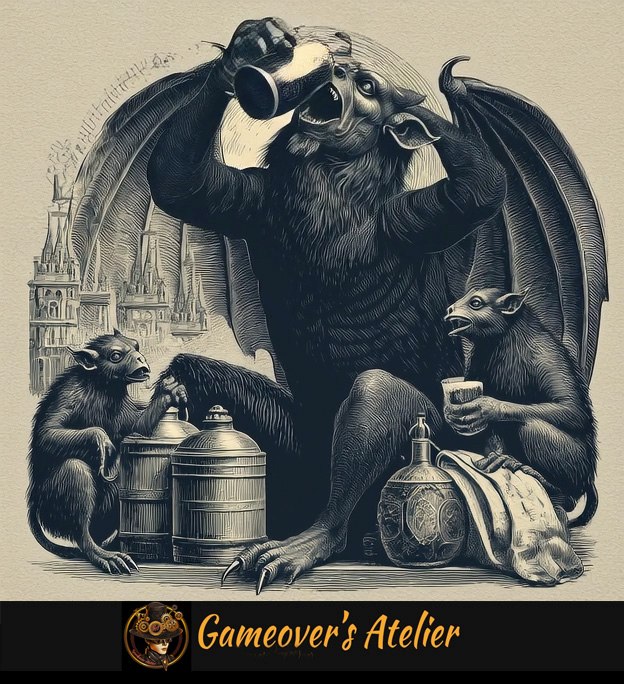
Gargoyle Party

You know those nights when the imagination decides to go off-script? That’s how I ended up making a tiny gothic clip where one devil gargoyle and two strange creatures, sneak away from their eternal duties and throw themselves a party on some forgotten cathedral ledge.
All of it looks like straight out of a 19th-century engraving — sharp lines, dark shadows, and a mood somewhere between mischievous and slightly tipsy.
It’s only a few seconds long, but watching a strange stone creature relax with a drink in hand feels oddly… wholesome.


More whimsical clips to come!

An own Print-On-Demand website?

Voilà, here it is!


How did I come to face such a feat?
First of all, for fun: I love making websites, that’s it. I had just completed a serious, demanding, challenging website – a historical archive – and needed to do something relaxing to rinse my brain… OK, that’s the truth, but not the whole truth: there was also a bit of commercial interest behind my resolution.

All began when I started visiting the usual popular Print-On-Demand sites…

… disguised as a buyer, in order to find out why I was selling so little on them – well, I actually did sell something there, but not enough to deserve any serious time or toil. I focused on the most obvious form of POD: the art that one hangs on the wall.

I was appalled by the prices:

would I buy anything that expensive myself? Definitely not! Unless perhaps in case of love at first sight, but that seldom happens.
Greed may certainly play a role in setting those high prices, but there must be something more to it. Let’s give it a thought:

First question:
why should one buy a framed work of art somewhere halfway around the world and pay the outrageous shipping costs, when the bare printout would travel much cheaper and faster in a cardboard tube?

Then all it would take is a walk to the do-it-yourself shop around the corner to have it framed according to one’s taste, in a self-chosen frame, maybe also with a sheet of real glass (rather than those horrible acrylic substitutes that would survive the shipping). Which would save about 3/4 of the total cost.

But that’s not all.

Second question(s):

who prints the work of art you choose, and on what paper, and what kind of printer do they use?
Most of the times the colors you see on your monitor don’t look very much like those you see printed on paper.

Who checks the color rendition?

And the diffusion effect?

And the overall quality of the finished work?

Then a disturbing thought came in without knocking:

of course the POD website gets the lion’s share, but also the printers must have their slice of the pie, and the packagers, and the shipment company… what’s left for the author is but laughable pocket change 🙁

Which encouraged briefly the sneaky temptation to bypass at least the POD sites and go directly to those sites that offer printing&shipment as a service… but alas, nothing doing: unguaranteed printing quality, long or very long processing times (up to 2 weeks!)… better forget it.

All of the above looks pretty disheartening, but I’m stubborn: my glorious printer can handle up to A3+ paper sheets (13” x 19”), quite a respectable size for a picture on the wall. A high-quality printing on it takes a mere couple of minutes of my time. I’m free to choose the best possible paper with the right grammage, texture and consistency. I have an encouraging constant number of visitors who show up in my websites, thus there’s no need for advertising…
So why not?
If it works, fine. And if it doesn’t, at least I learnt something new and had my fun 🙂

As a matter of fact I already had a lot of fun thinking of what would fit best on a wall and devising the proper mockup images to convey the mood to my visitors – here too MidJourney, adequately flogged and directed, proved to be a great limitless resource.

The yuck side: bureaucracy

Death and taxes are notoriously inevitable, and in this case the taxes were the belle of the ball: I had to comply with the EU legislation on VAT applied to member states, which makes a sharp distinction between digital goods (images made of impalpable bits) and tangible objects (images printed on palpable paper), thus taxing them slightly differently – bureaucrats love to wallow in such byzantine subtleties. Fortunately enough I have several websites, so I can place the impalpable stuff on one of them and the palpable stuff on another.

The novelty: Tarots on demand


While I was at it I also designed a couple of sets of author-signed tarots to be printed on demand.
It posed some challenges such as finding out the proper paper, learning how to laminate it, improvising a device to cut them out precisely by hand and round up the corners comme il faut, finding the right boxes to dress them up appropriately for their travel to the customer… live and learn 🙂

Have a look at them – you’ll find an (almost) classical deck as well as a retro-steampunk one with a pinch of humor scattered here and there – the latter, I confess, being definitely my favorite 😀

Dante’s Inferno Project

reposted
It has been quite challenging to produce (with the help of Midjourney) some spectacular and dramatic imagery inspired by the Inferno of Dante’s Divina Commedia.

Dante’s Inferno is a fascinating journey through the nine circles of Hell. This journey isn’t just for kicks; it’s about confronting the consequences of sin and understanding the need for repentance to reach salvation.

Dante places there historical figures and contemporaries, passing judgment on their deeds and misdeeds. It’s a personal and political elegant revenge, wrapped up in an epic narrative. Very cool of him.

From an aesthetic standpoint, the Inferno challenges and expands the boundaries of medieval imagination, blending horror and despair with complex allegories, making it a timeless piece that speaks of the eternal complexities of ethics.


You’ll find my images here.
I enjoyed this Midjourney’s ride, I hope you will too 🙂

Senior Gym

Visual Journey, embracing Flexibility and Strength in the Golden Years
A new collection at Gameover’s Atelier exploring per images the benefits of physical activity for seniors:
Improved Flexibility
Enhanced Strength & Muscle Tone
Better Posture & Balance
Increased Bone Density
Boost in Cognitive Functions
Portraits created using advanced artificial intelligence algorithms privately generated, intensively post-processed by (human 😉 ) hand and upscaled without losing resolution.

Midjourney 5.2 tells stories!

The new version 5.2 of Midjourney:
you can really tell a story now, with the introduction of the “zoom out” option and mixing it with the new “variation strong”.

My first attempt so far…

Indiana Jones close up
1 indy close up

then zoom out: Indy is on a boat in danger
2 indy zoom out

good, I want now a strong variation of the character on the same environment without zooming out
3 indy var

much better! now zoom out again

I like it! now another variation

now zoom out again introducing a bit of moonlight and Indy running away

…zoom out mooore!

Isn’t it beautiful?
Absolutely entertaining ;-D

To be or not to be…let’s ask ChatGPT

The Question occurred to me as, sitting in the subway, I suddenly realized that I was the only person really there: everyone else around me – mostly youngsters but not only – were elsewhere, looking blankly at their smartphones, occasionally tapping on them. Were those people really alive? Were they really thinking or were they rather ‘being thinked’ by some remote social?
Once at home I spent a while venting my unease into a sketch (with MidJourney’s help, but the unease was mine), and then very democratically I asked ChatGPT for its own opinion. Here’s the outcome, for you to judge and comment:

Q.

Hi Gpt! Today I’d like you to comment on a sketch showing Hamlet, Prince of Denmark, holding Yorick’s skull in his hand and muttering “To be, or not to be? Let’s ask ChatGPT”.
Hint: the new generations are becoming increasingly accustomed to have social media and electronic gadgets do the thinking in their stead; what effect will have a sophisticated AI on their mental laziness?
A sardonic and slightly humorous comment would be ideal. Are you up to it?

A.

As a sophisticated AI, I must say I find this sketch quite amusing. Hamlet’s famous soliloquy has been reimagined with a modern twist, showing how our dependence on technology and social media has become an integral part of our lives.
But to answer your question, the impact of AI on mental laziness is a topic of debate. While some argue that it may encourage people to rely too heavily on machines, others believe that AI can actually inspire people to think more creatively and critically by providing new tools and resources for problem-solving.
As for me, I believe that the relationship between humans and AI is a symbiotic one, where both parties can benefit from each other’s strengths. While AI can help us process vast amounts of information and perform complex tasks, it is ultimately up to us to utilize this technology in a responsible and thoughtful manner.
So, in conclusion, let’s not leave the decision of “to be, or not to be” to AI, but rather use it as a tool to help us make informed choices and enhance our own mental capabilities. After all, as Hamlet himself famously declared, “What a piece of work is man, how noble in reason, how infinite in faculties!”

AI: friend or foe? (5 of 5)

previous parts:
A very brief history of art: In the beginning…
A very brief history of art: growing up
A very brief history of art: today
A very brief history of art: fight them or join them?

A very brief history of art: where will it end?

Thus we’ll better cross off those ‘predictables’ that live on borrowed thoughts: to them it would make no difference whether a work is human- or AI-generated, and obviously decent AI works will sell cheaper than their human counterparts.
If we want something an AI can’t beat we should look for clients with a non-atrophic soul, a respectable culture and an independent mind of their own; comparatively rare as they can be, the humankind is still huge enough for them to constitute a respectable share of the market – anyway enough to support the real artists, if maybe not all those who tap the cellphone, upload the pic to Shutterstock and call it art.

Reaching such choosy, finicky, appreciative clients won’t be easy, and doing it alone looks pretty hopeless – the starving artist who tries to sell his great paintings on the sidewalk is a classic figure we’d rather avoid.
But the world hasn’t changed only for the worst: today we have an internet where many non-starving artists may join to offer their works to customers able to appreciate them. Or the same literate customers could gather and form a sort of very choosy ‘real art agency’ where only original, beautiful, unique works are accepted.

The brave new world

With a bit of luck there would be also some space left for the tap&upload ‘artists’: in order to supply the brave new microstock world the various AI’s will need to be fed with more and more new images, regardless of their quality.

OK, but…

… what if a particularly clever AI eventually manages to emulate a ‘soul’ of its own that a human cannot tell from a real one? Including attitudes, emotions and moods such as sadness, irony, anger, happiness, humor, enthusiasm, sarcasm and the like, in order to add a final touch of realism?

That would be an extended version of the famous Turing test, a philosophic minefield: if a machine succeeds convincing you (human) that you’re talking to another human being, then you should call it intelligent to all effects, like it or not.
You cannot pretend to play violin convincingly without mastering the art, right?

It’s pretty hard to swallow that much but, no matter how we may feel inside for reasons we ourselves cannot fathom, political correctness would demand that if an AI passes such a test we call it a human being: if we deserve equal treatment, respect and dignity regardless of our color, sex, origin, creed, mother tongue, intelligence, sexual orientation, shoe size and political affiliation, why should it matter if one is made of silicon chips and plastic rather than of flesh and bones?

THE END (so far…)

AI: friend or foe? (4 of 5)

previous parts:
A very brief history of art: In the beginning…
A very brief history of art: growing up
A very brief history of art: today

A very brief history of art: fight them or join them?

Yes, but how long will it last?
Hard to say: only six months ago one would have guffawed at the notion of a computer producing original creative images virtually indistinguishable from the ones made by a skilled artist. Now on that same notion we are crying aloud.
A machine has no soul but, if properly ‘educated’, it seems to be able to emulate pretty well one; by scanning thousands of human-made works it sort of ‘deduces’ what pleases us and imitates it plausibly enough. How long can take it to learn and imitate credibly also our newly found ‘human-only’ jobs?

That depends on the job, of course. Let’s be honest: when we paint, draw, write, sculpt or do anything else that we regard as human-only, we too use plenty of ready-made patterns we’re accustomed to – color combinations, common shapes, set phrases, easily detectable rules or identifiable styles… in the end only a small part of our work is really ours, all the rest is out-of-the-can.

It’s the way we assemble the out-of-the-can elements and merge them with our own ideas that makes the outcome unique.

Now, the AI has no ideas of its own; the originality of its work comes only from the input words we feed it with, most likely a little stirred by a random algorithm to prevent the machine from churning out identical outcomes from identical inputs.

Sadly enough though the same goes also for quite a number of people of flesh and bones: how many times did you hear “Man, he’s so predictable…”? How many people speak mostly (or only) in clichés? How many get their ideas, opinions, even beliefs mostly (or even only) from the community they live in, or from their favorite social?
I’m afraid that those people will be perfectly satisfied with the outcomes of an AI, no matter if it’s made only of out-of-the-can elements and a pinch of random.
Want a novel? Just enter
boy meets girl – parents oppose – girl runs away – boy follows her – rival appears – boy beats rival – happy ever after – Sugar Kissy style”,
upload it to www.romanticker.com *) and download a 300 pages bestseller that all the ‘predictables’ will buy eagerly. Just don’t tell them it’s AI-made, their social might not approve of it 🙂

**)

*) don’t try it, it doesn’t exist – yet.
**) image created with Midjourney and made swooning enough with postprocessing, not based on real persons.

next part:
A very brief history of art (5 of 5): where will it end?

AI: friend or foe? (2 of 5)

previous part:
A very brief history of art: In the beginning…

A very brief history of art: growing up

About six centuries ago an irresponsible Johannes Gutenberg invented the movable type printing, thus depriving thousands of guileless monks of the job they had devoted their entire life to. The catastrophe spread like wildfire: holy and less holy pieces of literature escaped the watchful hands of the Church and started spreading around information, concepts and ideas that bishops and kings would rather have kept confidential, thus pulling the cork off the Renaissance…
Just imagine all those monks and abbots groaning and moaning about the death of the art of calligraphy and as such of the literature as they knew it…

yet surprisingly enough Gutenberg’s felony didn’t kill the literature at all; it just stripped off its aura of holy and arcane and focused it more on the contents than on the form.

In the following centuries the worries raised by scientific and technological progress intensified exponentially: chemistry stole the work from alchemists, medicine from witch doctors and healers, the steam engine from horse breeders, physics and astronomy from theologians, the mechanical loom from weavers (remember the Luddites?), the internal combustion engine from the steam engine… the list could go on for quite a while.

Then after WWII the embers of a science that for a couple of centuries had been discreetly growing in the background without affecting much people’s life, ignited the fuse and the situation exploded: new technologies started popping up like mushrooms, newer technologies replaced them in a matter of a few years (or even months), the world began changing at an impressive speed.

Believe it or not, still in 1962 a computer was a human being, most often a woman, who performed a set of boring repetitive calculation manually or sometimes with the help of a few rattling mechanical gadgets. Less than four years later a bloom of electronic computers – bulky, clumsy, primitive but then regarded as lightning-fast – was already spreading on the world markets and stealing the job from innumerable grudging accountants and bookkeepers.

And today’s world was born.

next part:
A very brief history of art (3 of 5): today