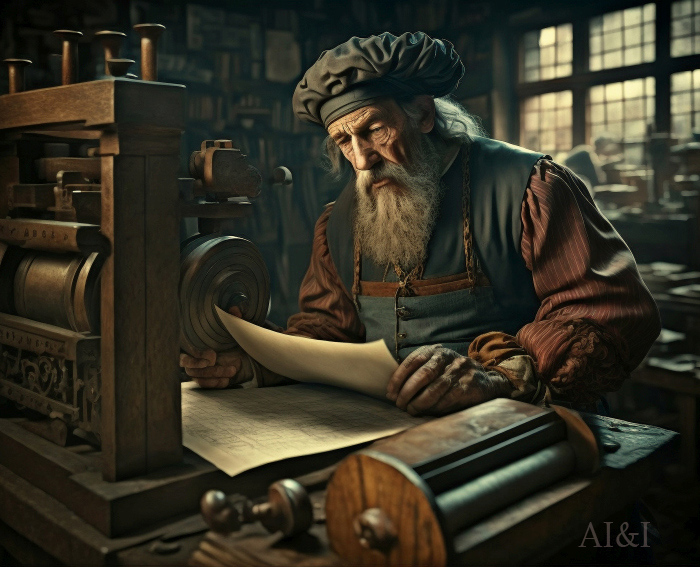
AI: friend or foe? (5 of 5)

previous parts:
A very brief history of art: In the beginning…
A very brief history of art: growing up
A very brief history of art: today
A very brief history of art: fight them or join them?

A very brief history of art: where will it end?

Thus we’ll better cross off those ‘predictables’ that live on borrowed thoughts: to them it would make no difference whether a work is human- or AI-generated, and obviously decent AI works will sell cheaper than their human counterparts.
If we want something an AI can’t beat we should look for clients with a non-atrophic soul, a respectable culture and an independent mind of their own; comparatively rare as they can be, the humankind is still huge enough for them to constitute a respectable share of the market – anyway enough to support the real artists, if maybe not all those who tap the cellphone, upload the pic to Shutterstock and call it art.

Reaching such choosy, finicky, appreciative clients won’t be easy, and doing it alone looks pretty hopeless – the starving artist who tries to sell his great paintings on the sidewalk is a classic figure we’d rather avoid.
But the world hasn’t changed only for the worst: today we have an internet where many non-starving artists may join to offer their works to customers able to appreciate them. Or the same literate customers could gather and form a sort of very choosy ‘real art agency’ where only original, beautiful, unique works are accepted.

The brave new world

With a bit of luck there would be also some space left for the tap&upload ‘artists’: in order to supply the brave new microstock world the various AI’s will need to be fed with more and more new images, regardless of their quality.

OK, but…

… what if a particularly clever AI eventually manages to emulate a ‘soul’ of its own that a human cannot tell from a real one? Including attitudes, emotions and moods such as sadness, irony, anger, happiness, humor, enthusiasm, sarcasm and the like, in order to add a final touch of realism?

That would be an extended version of the famous Turing test, a philosophic minefield: if a machine succeeds convincing you (human) that you’re talking to another human being, then you should call it intelligent to all effects, like it or not.
You cannot pretend to play violin convincingly without mastering the art, right?

It’s pretty hard to swallow that much but, no matter how we may feel inside for reasons we ourselves cannot fathom, political correctness would demand that if an AI passes such a test we call it a human being: if we deserve equal treatment, respect and dignity regardless of our color, sex, origin, creed, mother tongue, intelligence, sexual orientation, shoe size and political affiliation, why should it matter if one is made of silicon chips and plastic rather than of flesh and bones?

THE END (so far…)

AI: friend or foe? (4 of 5)

previous parts:
A very brief history of art: In the beginning…
A very brief history of art: growing up
A very brief history of art: today

A very brief history of art: fight them or join them?

Yes, but how long will it last?
Hard to say: only six months ago one would have guffawed at the notion of a computer producing original creative images virtually indistinguishable from the ones made by a skilled artist. Now on that same notion we are crying aloud.
A machine has no soul but, if properly ‘educated’, it seems to be able to emulate pretty well one; by scanning thousands of human-made works it sort of ‘deduces’ what pleases us and imitates it plausibly enough. How long can take it to learn and imitate credibly also our newly found ‘human-only’ jobs?

That depends on the job, of course. Let’s be honest: when we paint, draw, write, sculpt or do anything else that we regard as human-only, we too use plenty of ready-made patterns we’re accustomed to – color combinations, common shapes, set phrases, easily detectable rules or identifiable styles… in the end only a small part of our work is really ours, all the rest is out-of-the-can.

It’s the way we assemble the out-of-the-can elements and merge them with our own ideas that makes the outcome unique.

Now, the AI has no ideas of its own; the originality of its work comes only from the input words we feed it with, most likely a little stirred by a random algorithm to prevent the machine from churning out identical outcomes from identical inputs.

Sadly enough though the same goes also for quite a number of people of flesh and bones: how many times did you hear “Man, he’s so predictable…”? How many people speak mostly (or only) in clichés? How many get their ideas, opinions, even beliefs mostly (or even only) from the community they live in, or from their favorite social?
I’m afraid that those people will be perfectly satisfied with the outcomes of an AI, no matter if it’s made only of out-of-the-can elements and a pinch of random.
Want a novel? Just enter
boy meets girl – parents oppose – girl runs away – boy follows her – rival appears – boy beats rival – happy ever after – Sugar Kissy style”,
upload it to www.romanticker.com *) and download a 300 pages bestseller that all the ‘predictables’ will buy eagerly. Just don’t tell them it’s AI-made, their social might not approve of it 🙂

**)

*) don’t try it, it doesn’t exist – yet.
**) image created with Midjourney and made swooning enough with postprocessing, not based on real persons.

next part:
A very brief history of art (5 of 5): where will it end?

AI: friend or foe? (3 of 5)

previous parts:
A very brief history of art: In the beginning…
A very brief history of art: growing up

A very brief history of art: today

Now, half a century later, we’d feel naked and exposed without a laptop, a tablet, a smartphone, a smart toothbrush, an intelligent burglar alarm – and of course, running on them, software and firmware enough to smooth down any tiny fold in the fabric of our lives. And we’re still muttering.
OK, it’s very human to welcome the good with a nonchalant shrug (“Altana, scratch my back and get me a martini!”) and to reject the bad with disdainful contempt (“that bloody thing is eavesdropping on us all the time!”).
It’s perhaps less human but more honest to acknowledge that good and bad are two inseparable sides of the same coin: you want an electronic contraption to listen to all your whims but not to listen to what it shouldn’t? Oh, come on, every housemaid would do it!

What can we do to stop this wicked process before it swallows us all alive?
Bluntly and mercilessly, nothing.

Many tried to but no one succeeded so far: you may kill a man but not an idea, or a concept, or a piece of knowledge. The Holy Inquisition tried hard to gag Galileo for his heretic point of view about the universe, but she couldn’t prevent other scholars from weighing the Holy Scriptures against tangible evidence. A skilled scientist invents a device to dissolve all the bureaucrats in a puff of smoke (if only… 🙂 ); you may imprison him, even hang him, but you’ll never be sure that another one won’t come up with the same idea the next day.

Still perhaps we can do something to avoid being swallowed alive.

If you can’t fight them, join them…

that’s to say, while we reluctantly accept that a machine steals our job (we don’t seem to have much choice anyway) and acknowledge with poorly concealed envy that its work is sometime even better than ours, we can take advantage of it and meanwhile keep looking for something that the machine cannot do – metaphorically speaking, stop trying to make round vases and start decorating the machine-made ones with pictures that talk to the soul – whatever this word may mean. To the human soul, something a machine does not have. Invent a new job that only a human can do.

next part:
A very brief history of art (4 of 5): fight them or join them?

AI: friend or foe? (2 of 5)

previous part:
A very brief history of art: In the beginning…

A very brief history of art: growing up

About six centuries ago an irresponsible Johannes Gutenberg invented the movable type printing, thus depriving thousands of guileless monks of the job they had devoted their entire life to. The catastrophe spread like wildfire: holy and less holy pieces of literature escaped the watchful hands of the Church and started spreading around information, concepts and ideas that bishops and kings would rather have kept confidential, thus pulling the cork off the Renaissance…
Just imagine all those monks and abbots groaning and moaning about the death of the art of calligraphy and as such of the literature as they knew it…

yet surprisingly enough Gutenberg’s felony didn’t kill the literature at all; it just stripped off its aura of holy and arcane and focused it more on the contents than on the form.

In the following centuries the worries raised by scientific and technological progress intensified exponentially: chemistry stole the work from alchemists, medicine from witch doctors and healers, the steam engine from horse breeders, physics and astronomy from theologians, the mechanical loom from weavers (remember the Luddites?), the internal combustion engine from the steam engine… the list could go on for quite a while.

Then after WWII the embers of a science that for a couple of centuries had been discreetly growing in the background without affecting much people’s life, ignited the fuse and the situation exploded: new technologies started popping up like mushrooms, newer technologies replaced them in a matter of a few years (or even months), the world began changing at an impressive speed.

Believe it or not, still in 1962 a computer was a human being, most often a woman, who performed a set of boring repetitive calculation manually or sometimes with the help of a few rattling mechanical gadgets. Less than four years later a bloom of electronic computers – bulky, clumsy, primitive but then regarded as lightning-fast – was already spreading on the world markets and stealing the job from innumerable grudging accountants and bookkeepers.

And today’s world was born.

next part:
A very brief history of art (3 of 5): today

AI: friend or foe? (1 of 5)

A very brief history of art: In the beginning…

The following article is the result of a bloody fight between myself and a guy I married a few centuries ago. In the end we had to acknowledge that our points of view were virtually identical but neither of us wanted to admit it. So we reached a compromise: he wrote the article, I deleted the most politically incorrect remarks, he rewrote them in a milder form, I got a bunch of roses as an apology, he got a fine dinner. Occasionally marriage can be a great thing… 🙂

Lately I’ve read a lot of posts wailing, grumbling and moaning about the latest developments of AI potentially stealing the job from all kind of artists. Some of them looked reasonably well-informed, others gave the impression of a strong emotional position not really supported by any actual experience or direct knowledge.

Be it as it may, I think they could be right: if things keep going the way they are, plenty of ‘artists’ will inevitably lose their jobs as soon as their customers learn how to order a piece of art directly at the source, a skilled and most likely way cheaper AI. It’s just a matter of time, but the trend looks pretty clear.

However this is not the first time such a tragedy occurs: about four millennia ago some ruthless guy invented the potter’s wheel without giving a thought to the countless people his devilish invention would leave jobless: soon all those skilled artists capable of making a nicely round vase in less than a week saw their customers fade away and go buy for a ludicrously low price a perfectly round vase made in a quarter of an hour with the new gadget.
Still someone – probably a jobless artist – must have considered that the concept of ‘art’ could not be constrained to the way a beautiful thing is made: it might as well extend to the feelings such a beautiful thing elicits in us humans. And he (or she) started decorating those outrageously round vases with paintings that survived all the way to us, beautiful pieces of art having very little to do with the roundness of the support.

It’s sort of suggestive that for several millennia the Greek word τέχνη (téchne) has ever meant ‘art’ exactly in the sense we attach to this word today. Will that mean that in the course of time all arts are bound to get standardized and flattened into technology? I don’t know, I’m just thinking of another word, ‘artificial’…

Nor is this an isolated case…

next part:
A very brief history of art (2 of 5): growing up