AI: friend or foe? (2 of 5)

previous part:
A very brief history of art: In the beginning…

A very brief history of art: growing up

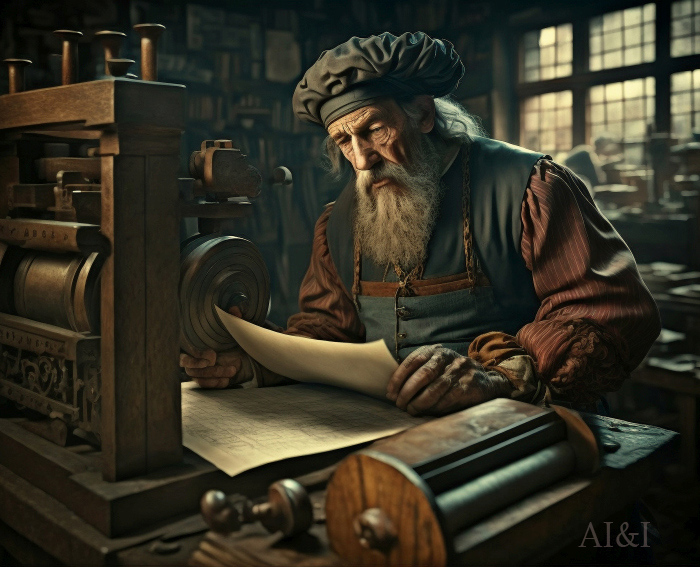
About six centuries ago an irresponsible Johannes Gutenberg invented the movable type printing, thus depriving thousands of guileless monks of the job they had devoted their entire life to. The catastrophe spread like wildfire: holy and less holy pieces of literature escaped the watchful hands of the Church and started spreading around information, concepts and ideas that bishops and kings would rather have kept confidential, thus pulling the cork off the Renaissance…
Just imagine all those monks and abbots groaning and moaning about the death of the art of calligraphy and as such of the literature as they knew it…

yet surprisingly enough Gutenberg’s felony didn’t kill the literature at all; it just stripped off its aura of holy and arcane and focused it more on the contents than on the form.

In the following centuries the worries raised by scientific and technological progress intensified exponentially: chemistry stole the work from alchemists, medicine from witch doctors and healers, the steam engine from horse breeders, physics and astronomy from theologians, the mechanical loom from weavers (remember the Luddites?), the internal combustion engine from the steam engine… the list could go on for quite a while.

Then after WWII the embers of a science that for a couple of centuries had been discreetly growing in the background without affecting much people’s life, ignited the fuse and the situation exploded: new technologies started popping up like mushrooms, newer technologies replaced them in a matter of a few years (or even months), the world began changing at an impressive speed.

Believe it or not, still in 1962 a computer was a human being, most often a woman, who performed a set of boring repetitive calculation manually or sometimes with the help of a few rattling mechanical gadgets. Less than four years later a bloom of electronic computers – bulky, clumsy, primitive but then regarded as lightning-fast – was already spreading on the world markets and stealing the job from innumerable grudging accountants and bookkeepers.

And today’s world was born.

next part:
A very brief history of art (3 of 5): today

AI: friend or foe? (1 of 5)

A very brief history of art: In the beginning…

The following article is the result of a bloody fight between myself and a guy I married a few centuries ago. In the end we had to acknowledge that our points of view were virtually identical but neither of us wanted to admit it. So we reached a compromise: he wrote the article, I deleted the most politically incorrect remarks, he rewrote them in a milder form, I got a bunch of roses as an apology, he got a fine dinner. Occasionally marriage can be a great thing… 🙂

Lately I’ve read a lot of posts wailing, grumbling and moaning about the latest developments of AI potentially stealing the job from all kind of artists. Some of them looked reasonably well-informed, others gave the impression of a strong emotional position not really supported by any actual experience or direct knowledge.

Be it as it may, I think they could be right: if things keep going the way they are, plenty of ‘artists’ will inevitably lose their jobs as soon as their customers learn how to order a piece of art directly at the source, a skilled and most likely way cheaper AI. It’s just a matter of time, but the trend looks pretty clear.

However this is not the first time such a tragedy occurs: about four millennia ago some ruthless guy invented the potter’s wheel without giving a thought to the countless people his devilish invention would leave jobless: soon all those skilled artists capable of making a nicely round vase in less than a week saw their customers fade away and go buy for a ludicrously low price a perfectly round vase made in a quarter of an hour with the new gadget.
Still someone – probably a jobless artist – must have considered that the concept of ‘art’ could not be constrained to the way a beautiful thing is made: it might as well extend to the feelings such a beautiful thing elicits in us humans. And he (or she) started decorating those outrageously round vases with paintings that survived all the way to us, beautiful pieces of art having very little to do with the roundness of the support.

It’s sort of suggestive that for several millennia the Greek word τέχνη (téchne) has ever meant ‘art’ exactly in the sense we attach to this word today. Will that mean that in the course of time all arts are bound to get standardized and flattened into technology? I don’t know, I’m just thinking of another word, ‘artificial’…

Nor is this an isolated case…

next part:
A very brief history of art (2 of 5): growing up