Dante’s Inferno Project

reposted
It has been quite challenging to produce (with the help of Midjourney) some spectacular and dramatic imagery inspired by the Inferno of Dante’s Divina Commedia.

Dante’s Inferno is a fascinating journey through the nine circles of Hell. This journey isn’t just for kicks; it’s about confronting the consequences of sin and understanding the need for repentance to reach salvation.

Dante places there historical figures and contemporaries, passing judgment on their deeds and misdeeds. It’s a personal and political elegant revenge, wrapped up in an epic narrative. Very cool of him.

From an aesthetic standpoint, the Inferno challenges and expands the boundaries of medieval imagination, blending horror and despair with complex allegories, making it a timeless piece that speaks of the eternal complexities of ethics.


You’ll find my images here.
I enjoyed this Midjourney’s ride, I hope you will too 🙂

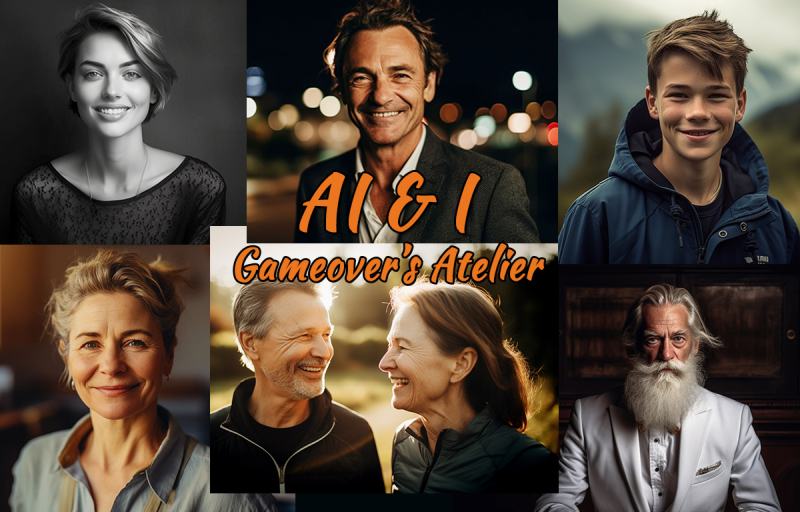
AI & I Lifestyle Portraits

Yes, I’ll admit that I felt a cold chill down my spine.
I’m pretty familiar with the ways of neural networks and as such I’m well aware that these portraits don’t depict any real person. No, they are artificially generated after processing zillions of human pictures to build up millions of ‘concepts’ about the way a human face should possibly look, and then by combining those concepts into always different images of non-existent people apparently having an own marked identity and personality.
But something within me wouldn’t listen to reason: they looked so incredibly real… thus in order to stifle once and for all that nasty inner voice I fed google with a number of them and asked it to look for similar ones online.
And… no match, nothing, zilch: those people simply don’t exist and never did. Period.


Which leads to a reflection:

according to the naysayers using an AI to generate images would infringe someone’s copyright, and using those images would be “stealing” other people’s work.

Yet applying such gut feeling… opps, ‘reasoning’ to those AI-generated human portraits doesn’t look terribly realistic: there’s no style to be stolen (not to mention that a style cannot be copyrighted), and no one could ever claim that their facial features have been used without their consent. Who’s rights are being infringed?

I agree, it’s understandable that lifestyle photographers and models may fear for the continuity of their job, not unlike the draftsmen when the first Autocad was released decades ago; but the disappearance of the drafting board didn’t kill their profession, it just moved it one notch up. For professionals flexible enough the new tools won’t be the gibbet’s trapdoor, they’ll be a door open on plenty of new unexplored ways to express their creativity.

Prompt & postprocessing

It should also be remembered (for those who forgot it) that getting decent AI-generated images is not just a matter of snapping fingers or pushing a button, in the same way as taking a decent photograph is not just a matter of tapping the smartphone and uploading the pic to Shutterstock

Issuing the right prompt entails more than a pinch of ingenuity, experience and creativity, and getting the image the way you like needs a good deal of patient experimentation and very accurate postprocessing, just like a real photograph.

Speaking of postprocessing, let me tell you about a curious aspect of it: it isn’t just a matter of conferring a particular flair, light and atmosphere to the AI-generated images. While inspecting my images at 100% after upscaling, I was disappointed noticing that they looked like illustrations rather than as real pictures. To fix that I had to contrive a not-so-simple Photoshop action that took good care of the inconvenience, and now I’m satisfied.

The portrait collection

Hope you’ll like my AI & I “portraits”.

I went for spontaneity and simplicity, no extreme fashion or makeup, just people like you and me and the ones we see while shopping.

Oh, I nearly fell desperately in love with the gentleman with silver beard and hair (in the lower right corner of the collage above). I took a dozen AI-snapshots of him, selected the best ones for you and kept the rest to myself. My husband is getting a little jealous and I think he’s growing a beard… 😉

AI: friend or foe? (5 of 5)

previous parts:
A very brief history of art: In the beginning…
A very brief history of art: growing up
A very brief history of art: today
A very brief history of art: fight them or join them?

A very brief history of art: where will it end?

Thus we’ll better cross off those ‘predictables’ that live on borrowed thoughts: to them it would make no difference whether a work is human- or AI-generated, and obviously decent AI works will sell cheaper than their human counterparts.
If we want something an AI can’t beat we should look for clients with a non-atrophic soul, a respectable culture and an independent mind of their own; comparatively rare as they can be, the humankind is still huge enough for them to constitute a respectable share of the market – anyway enough to support the real artists, if maybe not all those who tap the cellphone, upload the pic to Shutterstock and call it art.

Reaching such choosy, finicky, appreciative clients won’t be easy, and doing it alone looks pretty hopeless – the starving artist who tries to sell his great paintings on the sidewalk is a classic figure we’d rather avoid.
But the world hasn’t changed only for the worst: today we have an internet where many non-starving artists may join to offer their works to customers able to appreciate them. Or the same literate customers could gather and form a sort of very choosy ‘real art agency’ where only original, beautiful, unique works are accepted.

The brave new world

With a bit of luck there would be also some space left for the tap&upload ‘artists’: in order to supply the brave new microstock world the various AI’s will need to be fed with more and more new images, regardless of their quality.

OK, but…

… what if a particularly clever AI eventually manages to emulate a ‘soul’ of its own that a human cannot tell from a real one? Including attitudes, emotions and moods such as sadness, irony, anger, happiness, humor, enthusiasm, sarcasm and the like, in order to add a final touch of realism?

That would be an extended version of the famous Turing test, a philosophic minefield: if a machine succeeds convincing you (human) that you’re talking to another human being, then you should call it intelligent to all effects, like it or not.
You cannot pretend to play violin convincingly without mastering the art, right?

It’s pretty hard to swallow that much but, no matter how we may feel inside for reasons we ourselves cannot fathom, political correctness would demand that if an AI passes such a test we call it a human being: if we deserve equal treatment, respect and dignity regardless of our color, sex, origin, creed, mother tongue, intelligence, sexual orientation, shoe size and political affiliation, why should it matter if one is made of silicon chips and plastic rather than of flesh and bones?

THE END (so far…)

AI: friend or foe? (4 of 5)

previous parts:
A very brief history of art: In the beginning…
A very brief history of art: growing up
A very brief history of art: today

A very brief history of art: fight them or join them?

Yes, but how long will it last?
Hard to say: only six months ago one would have guffawed at the notion of a computer producing original creative images virtually indistinguishable from the ones made by a skilled artist. Now on that same notion we are crying aloud.
A machine has no soul but, if properly ‘educated’, it seems to be able to emulate pretty well one; by scanning thousands of human-made works it sort of ‘deduces’ what pleases us and imitates it plausibly enough. How long can take it to learn and imitate credibly also our newly found ‘human-only’ jobs?

That depends on the job, of course. Let’s be honest: when we paint, draw, write, sculpt or do anything else that we regard as human-only, we too use plenty of ready-made patterns we’re accustomed to – color combinations, common shapes, set phrases, easily detectable rules or identifiable styles… in the end only a small part of our work is really ours, all the rest is out-of-the-can.

It’s the way we assemble the out-of-the-can elements and merge them with our own ideas that makes the outcome unique.

Now, the AI has no ideas of its own; the originality of its work comes only from the input words we feed it with, most likely a little stirred by a random algorithm to prevent the machine from churning out identical outcomes from identical inputs.

Sadly enough though the same goes also for quite a number of people of flesh and bones: how many times did you hear “Man, he’s so predictable…”? How many people speak mostly (or only) in clichés? How many get their ideas, opinions, even beliefs mostly (or even only) from the community they live in, or from their favorite social?
I’m afraid that those people will be perfectly satisfied with the outcomes of an AI, no matter if it’s made only of out-of-the-can elements and a pinch of random.
Want a novel? Just enter
boy meets girl – parents oppose – girl runs away – boy follows her – rival appears – boy beats rival – happy ever after – Sugar Kissy style”,
upload it to www.romanticker.com *) and download a 300 pages bestseller that all the ‘predictables’ will buy eagerly. Just don’t tell them it’s AI-made, their social might not approve of it 🙂

**)

*) don’t try it, it doesn’t exist – yet.
**) image created with Midjourney and made swooning enough with postprocessing, not based on real persons.

next part:
A very brief history of art (5 of 5): where will it end?