The Café-Library — Open at Night

I’m quietly transforming my websites.
The idea is to offer full sets of selected images built around a focused idea — a set of visuals that share the same atmosphere and narrative thread, designed as a complete package ready for illustrators, designers, publishers, and anyone who needs consistent imagery with a strong personality and immediate usability.

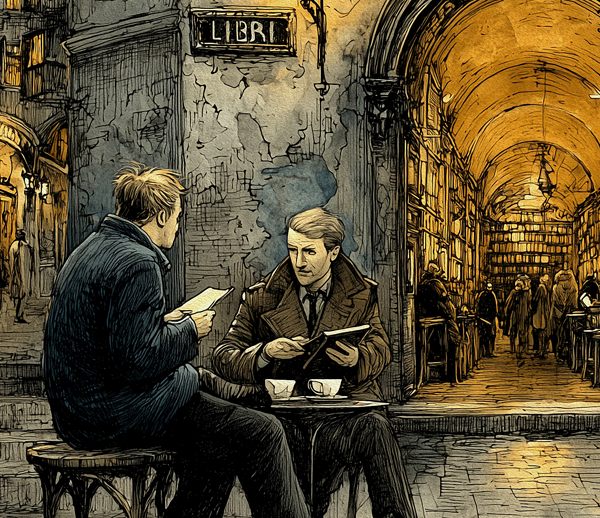
One of my curated sets is The Café-Library open at night
I’ve ever been and still am fascinated by books – don’t know how many thousands I have at home – thus the idea seems fabolous to me:

a bookshop-café open all night with the option to sit quiet and read a book (rented or bought), and at the first morning light, with a warm latte and a book in your hand, to go back to your place and sleep the day.

The atmosphere draws loosely from literary and real references – from Gianrico Carofiglio’s Osteria, to many brillant works of Walter Moers, to the Library Bar in Copenhagen.
Then came my imagination: the quiet pedestrian streets of an Italian downtown, dim light all around, most of it coming from a cheerful open bookshop with tables and seats outside or inside, with people sitting there, reading comfortably and sipping a coffee.
Every so often at the same table sit two people, occasionally they talk together but usually they are as good as alone, each one completely absorbed in their reading.
Sometimes under a vaulted ceiling of one of these coffee-bookshops someone sits at the piano in a corner and plays a soft tune.
Not easy feeding the feeling to Midjourney, but I’m happy with the result of a consistent, common atmosphere.

Et voilà some of the 16 selected images from the set:

In a time of constant distraction, the idea of a place dedicated to open, welcoming, uninterrupted reading looks quietly radical to me 😀

Une petite note for the AI-skeptics:

If you feel like writing a piece of poetry you’ll probably use a word processor, if only because today stylus, nibs and ink aren’t all that easy to find. And no one will dream of claiming that the real poet is the word processor you typed on and not you.
Things change if you use a sophisticated AI as a writing tool, but not by much: there’s still something essential, let’s call it ‘the human touch’, that you must provide yourself lest the outcome sound somewhat dull, insipid – even though there’s always the simpleton who takes the bite and congratulates, but that’s another story 😉

Same goes if you use a sophisticated graphic AI to give body to a dream you found in your mind, that otherwise would take you days or months to draw or paint with your own hands: if you want it to evoke the feelings that inspired you, the human touch must come from you.
Hard – if ever possible – to tell what this mysterious human touch really is: it’s something that you feel, not that you understand. Something related to the rustle of old pages under your fingers, to the smell of an ancient leather binding, to a gentle breeze ruffling your hair, to the taste of an early coffee, to the faint memory of a happy moment lost in the past… and this is as far as I go.
A tool is a tool is a tool.
Stock images: è giunto il momento del sito personale?

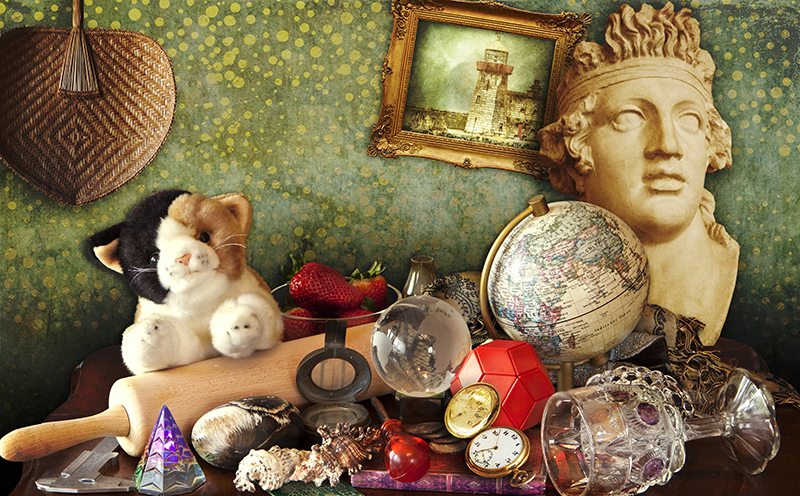
Mishmash objects with statue by Luisa Fumi.

Riflessioni sul microstock

Stato dell’ arte

Frequento non proprio ogni giorno ma quasi il forum microstockgroup popolato dai fotografi che contribuiscono con le loro immagini alle più conosciute agenzie di microstock. Così, per sentire il polso della situazione. Per lo più ne escono alti lai sul deterioramento della professione e sulle percentuali delle royalties sempre in diminuzione.
E’ vero, per i contributors la crisi c’è ed è in un buco nero.
Complice la diffusione di macchine fotografiche e smartphones sempre più perfezionati, il mercato è inflazionato: l’ offerta è enorme, di qualità da sufficiente a eccelsa. Le agenzie ne approfittano, i compensi calano. La concorrenza fra le agenzie stesse sembra sempre più spietata e le più piccole soccombono.

A cosa servono 100 milioni di immagini?

Le agenzie ora possono contare su perlomeno diecine di milioni di immagini.
Ma siamo sicuri che la scelta del cliente funzioni al top?
Come si fa ad arrivare all’immagine “giusta” se le statistiche dicono che la maggior parte degli utenti in una ricerca non va oltre la prima pagina o al massimo guarda le prime tre?
Sembra che le agenzie per non fare uscire sempre le stesse immagini in una data ricerca le ruotino, in parte random, in parte seguendo criteri che vengono aggiustati di volta in volta.

Mi chiedo se valga la pena di sprecare tanto tempo nel keywording che è la parte più noiosa dell’image processing. Ma soprattutto: che senso ha per un’agenzia possedere tante immagini se poi è come se ne avesse solo qualche migliaio da far vedere ?
Mi domando se non siamo anche qui in un buco nero di crisi.

Una via d’uscita

Forse è giunto il momento di rispolverare con altri criteri il sito personale, dove il fotografo vende da solo le proprie immagini.
Non un sito generico però, altrimenti ci confonderemmo con le piccole agenzie che hanno già vita difficile.
Un sito monografico su un argomento di interesse piuttosto ampio, che possa contenere qualche migliaio di immagini, ben studiato, diviso magari in gallerie secondo sub-categorie, facile da sfogliare dagli appassionati del genere: da chi cerca ad esempio immagini di sport, di difesa personale o alpinismo, di una certa regione Europea alquanto turistica, uno stile di vita vegano, concerti rock, energie sostenibili e altri temi molto attuali oppure un po’ retro tipo steampunk.
Magari aggiungendoci vicino un blog, che male non fa.
Pensate un po’ alle vostre passioni, a cosa vi piace fotografare di più: nel vostro cassetto (digitale) sono sicura che avete immagini in quantità.
In questa maniera le tanto sudate keywords estratte e divenute tags delle vostre pagine non vengono sprecate ma verranno usate da Google (o ancora meglio da Duckduckgo) per far trovare nelle ricerche proprio le vostre foto.
Parola mia, provato sulla mia pelle e funziona! 😀

Le vostre 2000 – 4000 immagini abilmente presentate e SEO ottimizzate possono farsi valere tutte e piazzarsi bene da sole con i motori di ricerca.

E poi perchè limitarsi ad un unico sito monografico? Sulla falsariga del primo potete crearne altri.
Coraggio, che forse una via di uscita c’è.

Dopotutto non occorre attirare milioni di visitatori e spendere follie in pubblicità quando ci si può permettere di tenere tutto il ricavato.

stock by .