I’m quietly transforming my websites.
The idea is to offer full sets of selected images built around a focused idea — a set of visuals that share the same atmosphere and narrative thread, designed as a complete package ready for illustrators, designers, publishers, and anyone who needs consistent imagery with a strong personality and immediate usability.
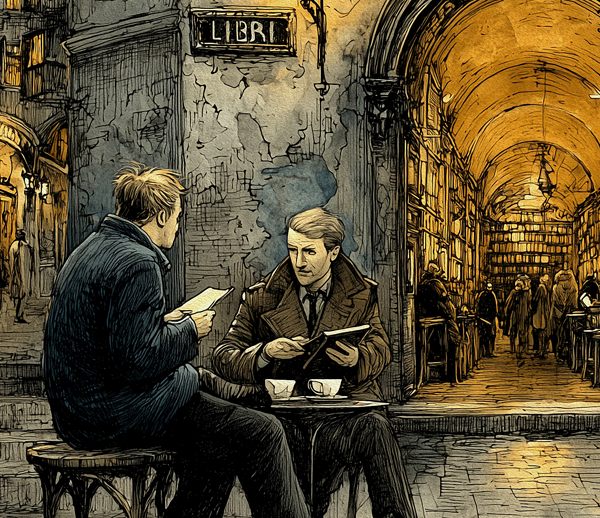
One of my curated sets is The Café-Library open at night
I’ve ever been and still am fascinated by books – don’t know how many thousands I have at home – thus the idea seems fabolous to me:
a bookshop-café open all night with the option to sit quiet and read a book (rented or bought), and at the first morning light, with a warm latte and a book in your hand, to go back to your place and sleep the day.
The atmosphere draws loosely from literary and real references – from Gianrico Carofiglio’s Osteria, to many brillant works of Walter Moers, to the Library Bar in Copenhagen.
Then came my imagination: the quiet pedestrian streets of an Italian downtown, dim light all around, most of it coming from a cheerful open bookshop with tables and seats outside or inside, with people sitting there, reading comfortably and sipping a coffee.
Every so often at the same table sit two people, occasionally they talk together but usually they are as good as alone, each one completely absorbed in their reading.
Sometimes under a vaulted ceiling of one of these coffee-bookshops someone sits at the piano in a corner and plays a soft tune.
Not easy feeding the feeling to Midjourney, but I’m happy with the result of a consistent, common atmosphere.
Et voilà some of the 16 selected images from the set:

In a time of constant distraction, the idea of a place dedicated to open, welcoming, uninterrupted reading looks quietly radical to me 😀
Une petite note for the AI-skeptics:
If you feel like writing a piece of poetry you’ll probably use a word processor, if only because today stylus, nibs and ink aren’t all that easy to find. And no one will dream of claiming that the real poet is the word processor you typed on and not you.
Things change if you use a sophisticated AI as a writing tool, but not by much: there’s still something essential, let’s call it ‘the human touch’, that you must provide yourself lest the outcome sound somewhat dull, insipid – even though there’s always the simpleton who takes the bite and congratulates, but that’s another story 😉Same goes if you use a sophisticated graphic AI to give body to a dream you found in your mind, that otherwise would take you days or months to draw or paint with your own hands: if you want it to evoke the feelings that inspired you, the human touch must come from you.
Hard – if ever possible – to tell what this mysterious human touch really is: it’s something that you feel, not that you understand. Something related to the rustle of old pages under your fingers, to the smell of an ancient leather binding, to a gentle breeze ruffling your hair, to the taste of an early coffee, to the faint memory of a happy moment lost in the past… and this is as far as I go.
A tool is a tool is a tool.