Just to recap my Websites

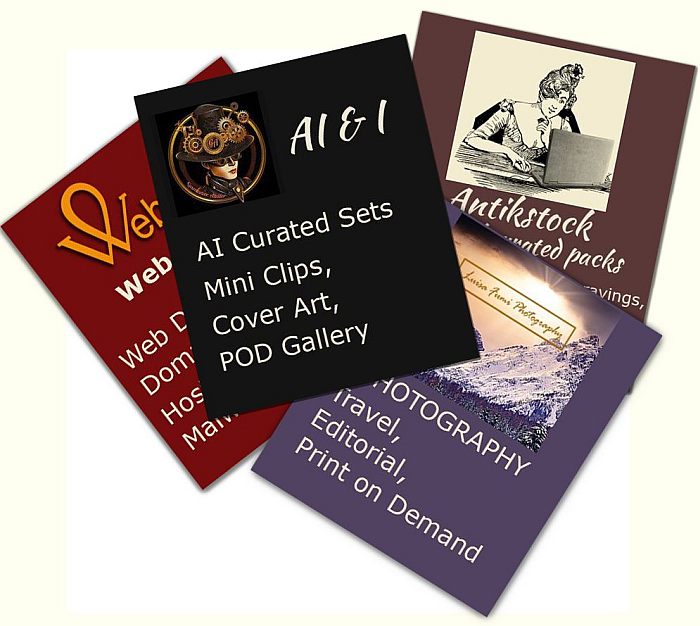
Online there are several websites of mine, each one with a specific purpose and leading theme, thus it’s pretty easy to get lost among them.
As my uncontrolled interests range farther than that, I think it’s a good idea to contrive a simple summary page like this:

Uh, oh may be it is a true addiction…
I just added a new website!

AI Art Microsets

Small AI Art collections ready to use – Small sets, small prices, no unnecessary complications.

Web-ankh [DE-IT]: is the site of my web services agency.

There are quite a lot of web services agencies out there, but I think I can offer also something more: in particular
– a thorough protection suite against web malware, inclusive of firewall, updating and frequent backups for just in case.
– plenty of experience about online shops to sell digital goods – comes in handy more often than you think.

Gameover’s Atelier AI & I: this site ( also reachable as Luisa Fumi Digital Art) reflects my unrestrained curiosity about AI-generated art.

I tested so many dedicated AI systems and I think that for the time being Midjourney is the best: not easy to prompt, sometimes sort of “moody” (laugh if you wish), but really unique as results.
Here I present the outcomes of my fights with Midjourney (only the ones I won 🙂 upsized and post-processed in a traditional way.
I’m enthralled by this experiment and keep having a lot of fun with them.

All the images are “ethical: they do not reference copyrighted characters, living artists, brands, or recognizable individuals.

To flesh out the site there are also a “Cover Art” section, a “mini-clips” page and a Print On Demand Gallery.

Professional photography: a site to show off my skills and my long extensive experience as photographer.

Mostly editorial and travel images from all around the world – untouched by AI hands 😊.
Hosted by Picfair, the site offers also a Print-on-demand service.

I’m thinking of expanding this site to more artistic stuff like exclusive cover art (a different taste from my corresponding AI covers). We’ll see.

Antikstock: last but definitely not least.
A rich collection of curated images (mostly engravings) from the past, all scanned from ancient books manically collected over a lifetime, all painstakingly restored from the damages of the centuries, all free from copyright issues (due to their venerable age).

I’m interested of images that speak to one another, forming complete visual worlds rather than disconnected fragments. Single images from the past, isolated from their context, often lose part of their meaning.

Working with historical imagery often means long research times, inconsistent quality, and stylistic mismatches.
Curated sets solve this by offering visual consistency, contextual coherence, and immediate usability:
press history, old magazine advertising, botanical art, medieval marine monsters, antique Egypt history and art… does it ring a bell?

And yes, I almost forgot it… there’s also my blog here.
I have a lot of fun writing it, hope you’ll enjoy reading it and commenting (unless you’re a troll – in which case you’ll be fed to our pirañas 😄).

Pruning the photostock agencies

Till death do you part…

Alas no, most of the times it doesn’t work like that: while between two people it takes plenty of patience, tolerance and forgiveness on both sides for a marriage to work fine until its natural end, between a person and a microstock agency things seem to be much harder – maybe because usually only one of the partners has a heart and a soul.
Be as it may, oftentimes the initial enthusiasm sooner or later drifts slowly into disillusion first, then into annoyance, and eventually into divorce.
Having gone through that unpleasant experience several times (with the microstocks, I mean – I still get along pretty well with my nasty old husband 🙂 ) I’ve learnt the hard way that even divorcing a microstock has a price, fair or outrageous depending on the agency. Let me share with you a few of those experiences, so that you may think twice before putting that confounded virtual ring on your finger.

First things first: why?

Because wasting time and toil for a few cents was never my favorite hobby, so I resolved to get rid of the agencies that in the last years had sold just a negligible number of my works.
Eventually I counted the dead: there were eight of them!

As a result I’m listing below the “won’t-miss-them” by star rating according to the smoothness of the parting.

Pond5:
The best. Smooth and gentlemanly parting.
Someone there asked me kindly why, I replied that all in all by them I wasn’t a best seller and parting was the best course of action. Soon after the same person sent me a kind email to confirm the account closure, a PayPal transfer notice to settle up and the promise that should I change my mind I’d be welcome back.
Worth a kiss!

Arcangel:
No hard feelings, with a frank and honest email exchange.
At first I had sold through them a couple of covers but that was it.
They were extremely choosy and I was increasingly skeptical because as a matter of principle they refused any job touched even remotely by AI, which at times like this doesn’t look very convincing to me.
But that’s not my problem, I wish them good luck.

Zazzle:
Simple and quick divorce, the only problem was to find the right web page, that as usual was well concealed.
I was making a little money by them but in the end personalizing various items using a rather cumbersome software wasn’t worth the time and toil. Too much work for too little.

FineArtAmerica:
Easy quick impersonal parting, no hard feelings (actually no feelings at all).
The last year I haven’t sold a hairpin by them, and no news from them.

Red Bubble:
Here too an easy fast impersonal parting, though somewhat sad on my side.
Through them I was selling some more than through other POD’s, I’ve been by them for several years and I was genuinely fond of them. But the day after they cut drastically the royalties I had no choice but leaving.

123RF:
No problem. Nor a word from them.

Dreamstime:

As a reply to my termination request I got an unpleasantly clear text:

“Please take into account that contributors are required to keep at least seventy (70%) percent of their portfolio online with Dreamstime.com for a period of at least six (6) months. You may disable all files older than six months from the date of review at any time. You will be allowed to disable a total of thirty (30%) percent of your total Media submitted within the past six (6) months. Media that was disabled and then enabled again will be counted as new submissions, no matter of their original upload date.”

Great: as punishment for my infidelity the images owned by me, on which I hold copyright, are held hostage for 6 months.
No doubt they are legally entitled to do so pursuant to some clause buried somewhere in the fine print that few contributors are likely to remember years later, but still…
They have been my first microstock agency, I stayed stubbornly with them until my royalties dropped below $100 a year, and even then I was saddened by the idea of leaving them. But as I read their reply my sorrow vanished like snow in the sun. Time flies…

Zoonar:

Same as above: apparently here too I’ve been a bad girl and thus my works are held hostage for 6 months.
I don’t remember for how long I’ve been keeping an account by them, however I found in my archive an email from Zoonar dated 12.05.2009.
Long story short: so far I haven’t attained their pay-off threshold yet — possibly also because quite a share of the images I submitted got usually rejected (and keep selling nicely on Adobe and elsewhere).
Such a pity that their communications concerning the cancellation of my account and the inherent restrictive conditions were not sent me per email as one would expect: if memory serves they only appeared fleetingly on my dashboard, and when I got back there to make a copy they weren’t available anymore. I also seem to remember a message about something concerning my PayPal account (also mysteriously vanished from my dashboard) that might prevent them from paying me off… a real financial catastrophe, but I think I’ll survive even without the €6.71 they still owe me 😀


Do I hear an “and what about Shutterstock?
Well, embarrassing as it is, I still retain a tokenish account by them. Since they cut their royalties to a few cents/image all I left by them was the picture of a (never sold) toilet paper roll, but so far I never deleted my account there.
Why? Please don’t ask 🙂

Bear in mind

Unless you have stolen them, your images belong to you: you shot them, you processed them, you keyworded them, you uploaded them, you own the copyright.

Some agencies will be fair and acknowledge that, some will expect to hold them hostage for months – just like an obnoxious partner would do with the children, although in this case they didn’t even contribute to their birth.

An excellent reason to read carefully the fine print before signing in.
Just saying…

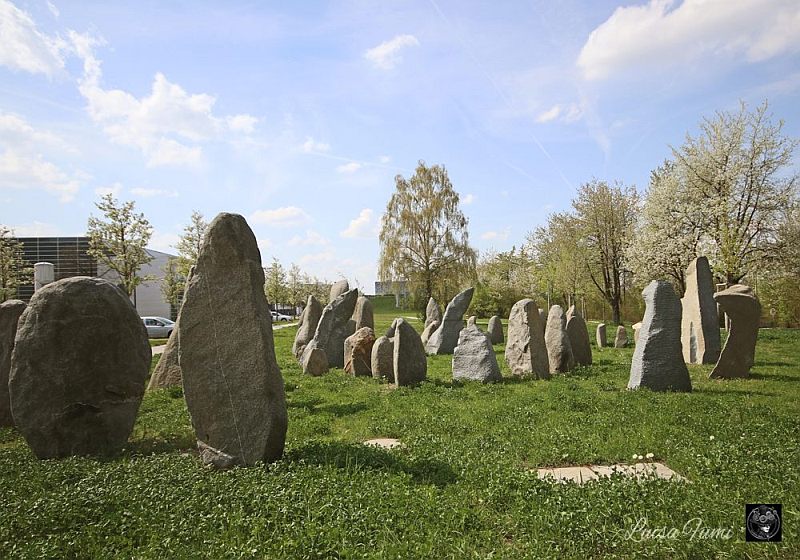
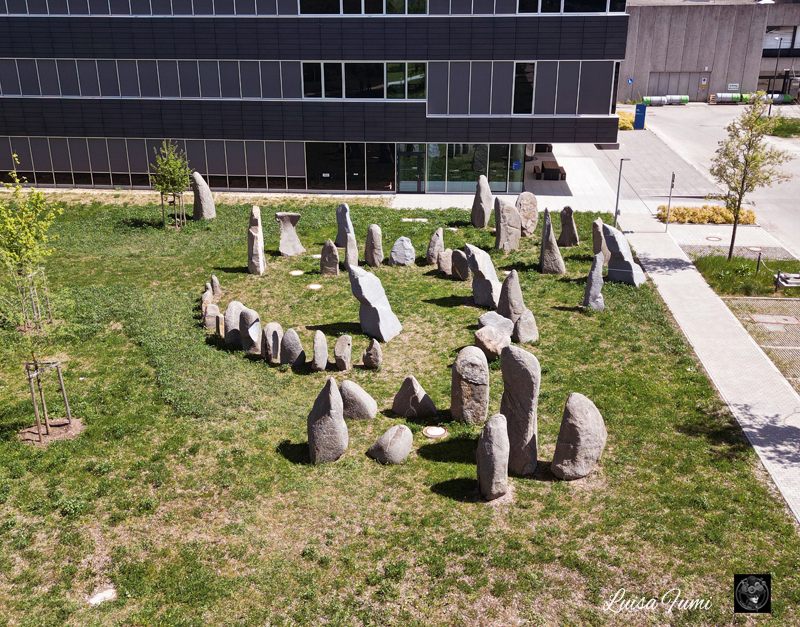
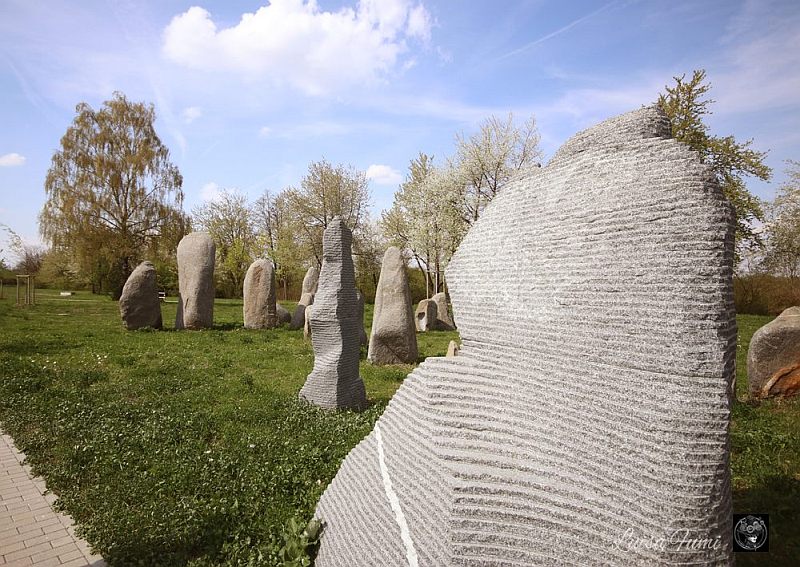
Editorial Photography: Quantumhenge

Formation of a quantumhenge” megalith monument of granite, artwork of Judith Neunhäuserer in front of the Center for Quantum Engineering at TUM campus in Garching of the Technical University of Munich.

The art inspiration was an iconic quantum experiment from Crommie M.F., Lutz C.P., Eigler D.M. “Confinement of electrons to quantum corrals on a metal surface“, in: Science. 1993. V. 262.P. 218ff. (painstakingly copied from the board there 🙂 )


Suggestive, indeed, and discovered by chance, driving along the campus.
The first impression was surprise “How! Why nobody told me that we have a megalith Stonehenge here!
Then came the curiosity.

Walking around it, I thought I saw a piece looking like the Rosetta stone inside the circle.


Worth a visit, definitely!

Venetian Graffiti n.2

My photo of another interesting graffiti on a Venice street wall
La patria sarà quando tutti saremo stranieri
literally:
There’ll be a homeland only when we’re all foreigners.

A paradox that overturns the traditional idea of homeland: not an identity that excludes, but a condition that includes.
Only when no one is “at home” can we all feel at home.
Is it utopia, or simply a definition still ahead of its time?

How to sell stock images today

preamble: a professional photographer asked me some hints to sell stock images. I answered her privately. Then I thought that a slightly fleshed-up version of it might also deserve a little corner on my blog.

For decades now I’ve been looking for some magic formula to sell good pictures on the web, and if I had run into an effective one I wouldn’t hesitate to pass it to you. But, alas, that seems fated to stay a dream.
Then let’s put aside the dreams and face today’s reality, so that we can realistically adjust our targets and methods to it, thus sparing us the worst disappointments:

1 – nowadays (and for quite some time) just everyone is a photographer – or believes firmly that she or he is one, even if all they do is tap the screen and upload the picture. What they lack in skills is amply offset by the hi-tech electronics inside the chatter can.

2 – most of the audience – the buying audience – don’t appear very interested in the quality of the images they purchase. I sold at a comparatively high price and/or in impressive quantities pictures that, if not totally dull, were nothing exceptional, whereas a number of really beautiful ones are still there awaiting their first buyer.
An example?
prosecco & pecorino

This image is one of my bestsellers at Adobe with 280 sales until now (from .38 to 26.40 USD each) and keep selling. I am the first to admit that it is nothing special, even if the composition and the content is good.

3 – There seems to be no rationale for the criteria they use to choose which images to purchase – or if there’s one I failed to see it in the last 16 years.

4 – Whoever buys the images prefers the big agencies over the small individual seller, no matter the price, the quality or the professionalism of the agency, as long as it has a name big enough. Possibly (just a wild guess of mine) for they pay out of their client’s pocket, not of their own.

And still, despite such a bleak scenario, I keep making decent money by selling images on the web. How?

In the first place I put in the freezer my ambition to make money by selling art: for my most beautiful pictures I have a couple of private websites that produce a few sales and a lot of satisfaction.

Then I discarded the smallest agencies. Why? Let me explain: I think that Dreamstime is a quite fair agency, but it takes me 2 years to make the same amount I achieve in less than a week by Adobe. Moreover, I would be competing against myself.
Actually I’m selling pretty well at Alamy (the best for me), Adobe and Istock. I obviously discarded Shutterstock, leaving there (in my still open account) only a toilet paper still life.

toilet paper

As for the small agencies, I deleted most of my images there but left my account open: should the situation change I might reconsider coming back again. Except for the ones I really dislike: by them I deleted everything and disappeared in a puff of smoke (a name? Wirestock).
With this tactical approach I saw my income soar… well not enormously but significantly.

And I began listening to the old saying “when you go fishing put a worm on the hook: it’s the fish that must like it, not you” and uploading to the agencies mostly nice but quite ordinary pictures, the kind ordinary people would like and buy.

I hope this helps you rather than discourage you…

The Krampus Parade

It was quite cool to recreate with Midjourney a Krampus night 🙂

What is a Krampus?

It’s a big hairy creature, a blend of beast and human, with horns, a long pointed tongue, fangs, and a very convincing devilish look. The roots of the tradition date to an unspecified pre-christian era, from the European alpine regions.
Several centuries back the heathen Krampus folklore was engulfed into the Christmas tradition as a dark counterpart to St. Nicholas, to remind (mostly the children, but not only) of the possible effects of being naughty rather than nice.
Dozens of such ominous half-goat, half-demon creatures roam the streets during the Christmas season (5th-6th December) rattling chains and bells to warn or punish those who haven’t behaved properly (actually all the bystanders, not a bad assumption 😉 ).
The Krampus parade annual event is really a spine-chilling and oddly fascinating show: it takes more than a while to realize that inside those sinister figures there are playful men that every now and then stop and take off their demonic horned heads to drink a beer or play with absolutely delighted children.

The dark and the wild

Have a look at my AI & I collection and enjoy the gothic artistic side of the Krampus depicted by flogging MidJourney long enough.
13 beautifully suggestive images – occasionally with a hint of humor,

The practical and the funny

If you want to have a look at the real side of the ‘Krampusses’ – to balance the macabre with the fun – just look at my editorial images of the “backstage” of the annual Krampus Run in Munich These are 100% real, live, no AI involved.

The participants take their Krampus get-ups very seriously and spend a lot of money throughout the year to bring the evilness of their creation to perfection: elaborated barbaric fur outfits, heavy artistically carved wooden masks, monstrous horns, long lolling tongues – and more, much more. It’s a great experience to watch those big friendly guys happy even if exhausted by the fatigue of wearing those incredibly heavy costumes, graciously posing for a selfie and accepting kindly the curiosity of the viewers.

As in so many other occurrences, here too the AI complements admirably a professionally used camera, the one siding with fiction, the other with reality. The conflict is so often in the eye of the beholder…

Using the DJI Pocket 2 in an unconventional way

DCIM100MEDIADJI_0008.JPG by .

This is me in an ectoplasm version, having plenty of ghostly fun with my new camera.
My husband and I gave ourselves a Christmas gift in advance: the new DJI Pocket 2: a tiny pound of pocket-size camera with a great sharp sensor and a gimbal head allowing absolutely smooth 4K video clips at a very affordable price.

But I’m not going to describe the characteristics of this great new gadget here, you can find much more on YouTube and on specialized reviews. As I am not particularly fond of movies (I like still pics much more) I wondered if this pocket-size camera could replace in some way my good old one.
No sooner said than done, I began taking shoots outdoors and indoors with both and then comparing the outcomes.

My first images were accepted at Adobe, Alamy and Arcangel without arching a brow.

Voilà some of them:

Not bad at all 🙂

One promising alternative to the self-hosted site: Picfair

luisa-photogr3-1000 by .

I always hear the same refrain: yes, they are fair indeed, pity though that they don’t sell much…
Actually so far my experience at Picfair had been… fair: for a few years I’ve been putting every now and then some images there, having three or four sales promptly paid in the meantime.

But times seem to be changing, and I decided that I need a personal photo website. I would know pretty well how to set up one myself, but for a small yearly fee Picfair offers me the possibility to have it under my own name, and as a very nice bonus also to sell my pictures as prints/posters/framed. So why not to give it a try?

So be it: luisafumi-photography.com
The presentation of the images is very good, and I can (beside having an URL of my own by them):
– sell prints,
– make albums and feature one on the first page,
– have a local search engine,
– create a splash page with a picture I love
– add external links to the menu (to my blog here, to my other website vintage-nostalgia.com, etc.)
– have a personal watermark. I retained the Pifair standard one, very well thought and designed, also because I am happy to be there in excellent company, as I find the overall Picfair image quality astonishingly high.

Time will tell if such a decision will be fruitful – now it is to early to make a reliable forecast about the destiny of the photo market at all.

Just few days after my new Picfair installation I was rewarded with a pleasant surprise: my first print sale, my splash image! A good omen and a nice startup.

SPLASH-PICFAIR-600 by luisa fumi.

Microstock Armageddon?

luisa-photogr2-1000 by .

Find you niche(s)!

I fear that Shutterstock has given the final blow to the microstock photos market with their unilateral action, by reducing drastically the contributors royalties to 10 cents/picture – promising more for big amounts of uploads and sales, but resetting the contributor at the beginning of each year – that is, forcing her/him to start from scratch @10 cents/sale, and thus humiliating legions of outraged submitters.
And I also fear that this deliberate act is actually a farsighted move: the SS people must have realized that the time was ripe to grab as much as possible before going out of business.
Just look around: the websites offering high res images for free are rapidly growing and some of their pictures are really beautiful, also considering that today’s smartphones are growing better endowed than most photographers.

What to do now?
I’m thinking of two possibilities:

1. Business is business: to upload all of one’s images on all agencies that sell (if just a little) in exchange for a decent (if just a little) royalty, and to hope for the best.
Alas, there is a heavy drawback about it, tough: a couple of years ago I withdrew almost all my images belonging to a particular well-selling niche from the less profitable agencies. As it happens, it proved to be a blatantly fortunate manoeuver: my sales at Alamy and Adobe more than doubled immediately. And they keep growing.
This way I understood that I was my own cheap competitor. When 123RF contacted me on behalf of a customer about a deleted image of mine, I told them that I was really sorry and explained candidly my problem. Quite surprisingly they accepted my point of view and respected it.

2. To accept the change without moaning and make plans. To leave and to upload your images on the trustworthiest agencies, but to keep aside the best ones and find other more profitable ways to sell them.

Still I think that the idea of a personal stock agency is worth a thought or three anyway – no matter if self-hosted or not: there are several alternatives on the market and at least two of them are very affordable (I’ll tell about them in a next post).
It could turn into a precious show-window for the images you like too much to give them away cheap.

At this point it wouldn’t surprised me to witness a revival of many curated niches over the mass cauldron.
Since many years I’m not only a contributor, but on behalf of my web customers also a microstock buyer, and as such I’m perfectly aware that my behaviour doesn’t deviate much from the vast majority of buyers, who statistically give up after the second page the local search engines produce.
And what with the tenths of millions of images stored by the agencies? Dead, almost completely dead.

Nowadays selling microstock is like winning a prize at a cheap lottery called “search engines”: partially random, partially influenced by hidden rules and only marginally based on the actual, hard-labored keywording.

What’s the point of such zillions of dead images, when just a few thousands of high-quality pictures, if well presented and properly selected, could make a really huge difference?

A pebble in the pond: a free Artists’ Marketplace

stock3 by .

For nearly a month (since the infamous 1st of June) a couple of disquieting questions have been bouncing back and forth within my skull:
what are we to do if/when the other agencies follow Shutterstock’s despicable example and start treating their contributors like beggars?
How come a fair agency like Picfair appears to sell nearly nothing even though they offer such awfully great pictures?

I do know all too well what it’s like to set up a photostock agency – I did it. Once you solve the technical problems (quite a hard cliff themselves) and get it to run fine, you find out to your dismay that keeping it up and running – server fees, updating, de-hacking, automation, you name it – is way more expensive (at least in time) than you optimistically thought when you started.

No, I don’t really think that setting up a new agency – with so many small ones out there struggling to survive – would be a solution. What we need is a new concept, something that would entice anyone who needs one or more images having specific requirements. The cue came from Alex Rotenberg as he told us how a customer, unable to find his images on Shutterstock any longer, got directly in touch with him.

So why not to put in contact clients and contributors, thus bypassing the agencies?
All it would take would be a surprisingly cheap and simple no-profit site, a sort of artists’ cooperative dedicated to illustrations, photos and video clips, where potential clients may freely ask for images having some specific features. Their requests appear on a board and get immediately sent per E-mail to all photographers who subscribed (for free).
A mother knows her baby, a photographer knows his/her images: the one who has an image that may satisfy the client (say, a kid playing in a puddle) replies uploading ASAP one or more watermarked images onto a page that only the client may access.

That would be really big news: a thoughtful human response, no AI at all, no 300 pictures of the same lonely puddle in the park taken from 300 different angles. And no time wasted on keywords ( do we all loathe them!)

As far as prices are concerned, that’s all to be seen: fixed price, normal and premium, private negotiation… a matter of taste. However the cooperative rules must be simple and clear, and accepted by all subscribers; that’s important, the one who doesn’t play fair gets kicked out without ceremony.
The site would be extremely simple – though attractive – and wouldn’t require any special server performances, or large amounts of memory, or special skills to run it. The only costs would be:

  • annual server rent (not much).
  • software maintenance (not much if regularly performed, but it must be done weekly to keep the software up to date and to prevent possible undue intrusions, malware and hacking).
  • start-up software development and further expansions if the initiative is successful (affordable).

No commission on sales – we’re talking of a no-profit initiative and this way it shall stay, lest greed creeps in and shatters(tocks) it to crumbles 🙂

The expenditures above would be covered by all subscribers after their first sale; if some 1000 – 1500 artists gather and join, it would be a matter of a few $ each yearly – transparent management, all expenditures publicly documented, no hidden costs.

Of course there should be a page telling the cooperative’s history and its goals, with a nice name (how about “Shutterstock’s castaways”?) and some well-groomed galleries of monographic pictures about current topics, something like the Photocase’s ones.

Maximum publicity to all successful sales on the site.
No a-priori exclusive, though it may be individually agreed with the client case by case.

All the above should obviously be discussed in detail once (if) this initiative takes shape and color. Mine is just a stone I’m throwing in the pond, let’s see now if it makes any waves…