Optical illusion: sign broken

Casual, out of curiosity, just for fun as seen out of my window:

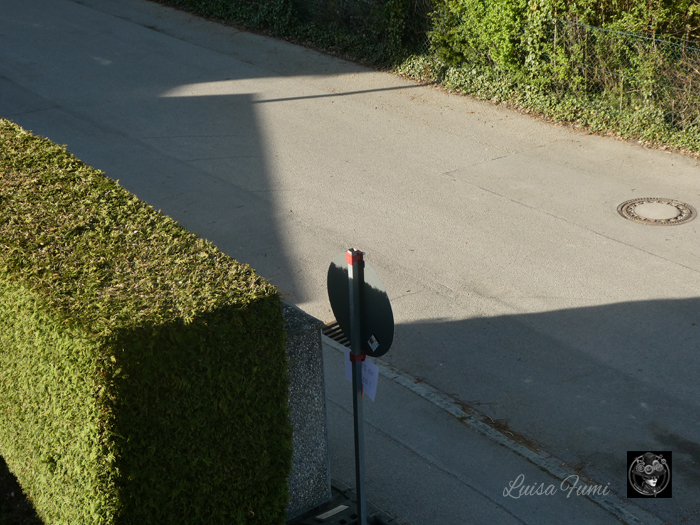
Construction site, plenty of no-parking signs (as as if one could park here at all…).

At one specific hour in the afternoon you look down and… wow, as if a giant had chomped off the upper part of the sign!
But no, that’s just the shadow of the hedge that darkens the lower part of the sign, while the rest mingles perfectly with the asphalt behind it.


😀

Venetian Graffiti n.2

My photo of another interesting graffiti on a Venice street wall
La patria sarà quando tutti saremo stranieri
literally:
There’ll be a homeland only when we’re all foreigners.

A paradox that overturns the traditional idea of homeland: not an identity that excludes, but a condition that includes.
Only when no one is “at home” can we all feel at home.
Is it utopia, or simply a definition still ahead of its time?

Venetian Graffiti

My photo of a whimsical graffiti on a Venice street wall
Non c’e più nessun Virgilio a guidarci nell’Inferno
literally translated:
There’s no more Virgil left to guide us through Hell

We’re lost in the dark, and this time there’s no teacher, no poet to show us the way.
Maybe we burned our Virgils, or maybe we just stopped listening.

How to sell stock images today

preamble: a professional photographer asked me some hints to sell stock images. I answered her privately. Then I thought that a slightly fleshed-up version of it might also deserve a little corner on my blog.

For decades now I’ve been looking for some magic formula to sell good pictures on the web, and if I had run into an effective one I wouldn’t hesitate to pass it to you. But, alas, that seems fated to stay a dream.
Then let’s put aside the dreams and face today’s reality, so that we can realistically adjust our targets and methods to it, thus sparing us the worst disappointments:

1 – nowadays (and for quite some time) just everyone is a photographer – or believes firmly that she or he is one, even if all they do is tap the screen and upload the picture. What they lack in skills is amply offset by the hi-tech electronics inside the chatter can.

2 – most of the audience – the buying audience – don’t appear very interested in the quality of the images they purchase. I sold at a comparatively high price and/or in impressive quantities pictures that, if not totally dull, were nothing exceptional, whereas a number of really beautiful ones are still there awaiting their first buyer.
An example?
prosecco & pecorino

This image is one of my bestsellers at Adobe with 280 sales until now (from .38 to 26.40 USD each) and keep selling. I am the first to admit that it is nothing special, even if the composition and the content is good.

3 – There seems to be no rationale for the criteria they use to choose which images to purchase – or if there’s one I failed to see it in the last 16 years.

4 – Whoever buys the images prefers the big agencies over the small individual seller, no matter the price, the quality or the professionalism of the agency, as long as it has a name big enough. Possibly (just a wild guess of mine) for they pay out of their client’s pocket, not of their own.

And still, despite such a bleak scenario, I keep making decent money by selling images on the web. How?

In the first place I put in the freezer my ambition to make money by selling art: for my most beautiful pictures I have a couple of private websites that produce a few sales and a lot of satisfaction.

Then I discarded the smallest agencies. Why? Let me explain: I think that Dreamstime is a quite fair agency, but it takes me 2 years to make the same amount I achieve in less than a week by Adobe. Moreover, I would be competing against myself.
Actually I’m selling pretty well at Alamy (the best for me), Adobe and Istock. I obviously discarded Shutterstock, leaving there (in my still open account) only a toilet paper still life.

toilet paper

As for the small agencies, I deleted most of my images there but left my account open: should the situation change I might reconsider coming back again. Except for the ones I really dislike: by them I deleted everything and disappeared in a puff of smoke (a name? Wirestock).
With this tactical approach I saw my income soar… well not enormously but significantly.

And I began listening to the old saying “when you go fishing put a worm on the hook: it’s the fish that must like it, not you” and uploading to the agencies mostly nice but quite ordinary pictures, the kind ordinary people would like and buy.

I hope this helps you rather than discourage you…

De profundis

Paddle steamer in the storm by copyright luisa fumi.

It takes so little to kill the last glimmer of hope… I complained to Alamy about their mass-few-¢-sale of this month, and in reply I got this :

Hi Luisa,
Thanks for your email. I can see that these sales are through our distribution scheme. Which you are opted in for.
Our Distribution scheme is optional and under the section of your account titled “Additional Revenue Option”. As the title suggests it’s an opportunity to earn additional revenue through territories that Alamy doesn’t quite reach with direct sales. Every year our Distribution scheme returns a sizable 15% of our total revenue and so we’d recommend being part of it.
You can only opt out or remove countries in April of every year; this is so we can give our distributors a consistent collection.

Kind regards,
Chantelle

(note: I opted out from their ‘Novel use’ option last April 1st)

Let’s brush off the tiny coat of perfunctory politeness and have a closer look at the gist:

  • So I’m “opted in for”: did I opt in or was I opted in? I don’t remember having checked a box “feel free to sell my images for a few pennies and give me a minute fraction of that”.
  • If their Distribution scheme returns “a sizable 15% of their total revenue”, how many millions of images should they sell on the ‘miserable’ market to make 2¢ for the distributor, 2¢ for themselves and 1¢ for me, and still have a decent income?
    The 22 images of mine they undersold this way got them a total of $1.55 and a mightily irritated contributor about to abandon ship. Perhaps the time has come to move the rampant yuppie who had the Great Idea to the cleaning team.
  • So nice that I can opt out of such an economical disaster in April of every year, indeed. It would be even nicer though to know what exactly one has to opt out of in order to prevent one’s images from being given away like confetti.

“Fair play” has many opposites, and nowadays keeping the rules where nobody sees them has become a very popular one.

There is little doubt left, they definitely are shutterstocking. It’s damn sad to see an agency that used to have fair play as their flagship sink this low 🙁

GRASP ALL, LOOSE ALL

scrooge by .

Old proverbs contain plenty of ageless wisdom. If only people noticed this timely…

Unfortunately though the top-level managers of the microstock agencies seem to be too busy to devote their valuable time to such menial thoughts. Rumors have it that sooner or later, while watching complacently the increasing revenues, a brilliant notion pops out between some rosy-cheeked executive’s ears: “Why should we leave so much money in the hands of the morons that hand us their pictures? We have the market, we have zillions of well-selling images, we dictate the rules.

We all know where that leads: it’s the so-called “Shutterstock effect”. Curtail drastically the contributors’ shares, sell lots of images at bargain prices, give to the beggars their two cents, ignore the chorus of moans, anger and insults that raises from the rabble, see your income grow, shake hands with the colleagues, I’m a genius!

And then, after a few months, the backlash: many contributors feel cheated or even insulted and close their accounts, many more delete their best pictures leaving behind just crap a blind man wouldn’t buy, the incoming flow of images drops to a trickle, the buyers notice the drop in quality and go buy elsewhere, the income curve falls miserably (dammit, maybe with some Viagra…).
And eventually the friendly suggestion “you better start looking for a new job”. But then it’s too late, the damage is done.

Sad as it is, now it appears to be Alamy’s turn. In the last days, without warning or asking for an OK, they surprised the contributors world by selling off a large number of pictures for a few cents, and those who demanded an explanation whatsoever bumped their heads against a pretty long local holiday – no one there to reply, what a coincidence!
One could hope that it’s just a misunderstanding of sorts, perhaps a glitch in the software or a silly human error, but the symptoms are all too clear, and the suspicion that Alamy is shutterstocking is overwhelming.

That’s quite a shock indeed: not long ago they still had a spotless reputation as an agency that cared for the contributor’s satisfactions, paid reasonably fair shares, and provided good help when needed. More than a little demanding perhaps, if you think of the ordeal of keywording it adequately, but you cannot expect such a high-level agency to accept just any picture: they sell excellent quality and are entitled to demanding it.
They are my agency, we do a good job together… good old days? 🙁

Where will all this end? Hard to say that without a top-grade crystal ball and some powerful psi powers. However, judging by the microstock market trend in the last couple of years, a reasonable modicum of pessimism would suggest that most of the major microstock agencies will slowly (or even not so slowly) collapse under the weight of their own greed.

The scenario we could expect in a near future might show us two or three large surviving microstock agencies selling mediocre images very cheap by the ton on behalf of countless grumbling but resigned private contributors, a few ad-supported artistic websites selling very little, the usual lot of websites offering as “windows backgrounds” good images for free (but for personal use only).
And, with a bit of luck, a constellation of sites owned, managed and constantly fed by skilled photographers and graphic artists offering directly to the buyer very high quality images at a fair price, no bloodsucker share included.

If you want the best apples at a decent price, go knock directly at the farmer’s door…:-D
Using the DJI Pocket 2 in an unconventional way

DCIM100MEDIADJI_0008.JPG by .

This is me in an ectoplasm version, having plenty of ghostly fun with my new camera.
My husband and I gave ourselves a Christmas gift in advance: the new DJI Pocket 2: a tiny pound of pocket-size camera with a great sharp sensor and a gimbal head allowing absolutely smooth 4K video clips at a very affordable price.

But I’m not going to describe the characteristics of this great new gadget here, you can find much more on YouTube and on specialized reviews. As I am not particularly fond of movies (I like still pics much more) I wondered if this pocket-size camera could replace in some way my good old one.
No sooner said than done, I began taking shoots outdoors and indoors with both and then comparing the outcomes.

My first images were accepted at Adobe, Alamy and Arcangel without arching a brow.

Voilà some of them:

Not bad at all 🙂

One promising alternative to the self-hosted site: Picfair

luisa-photogr3-1000 by .

I always hear the same refrain: yes, they are fair indeed, pity though that they don’t sell much…
Actually so far my experience at Picfair had been… fair: for a few years I’ve been putting every now and then some images there, having three or four sales promptly paid in the meantime.

But times seem to be changing, and I decided that I need a personal photo website. I would know pretty well how to set up one myself, but for a small yearly fee Picfair offers me the possibility to have it under my own name, and as a very nice bonus also to sell my pictures as prints/posters/framed. So why not to give it a try?

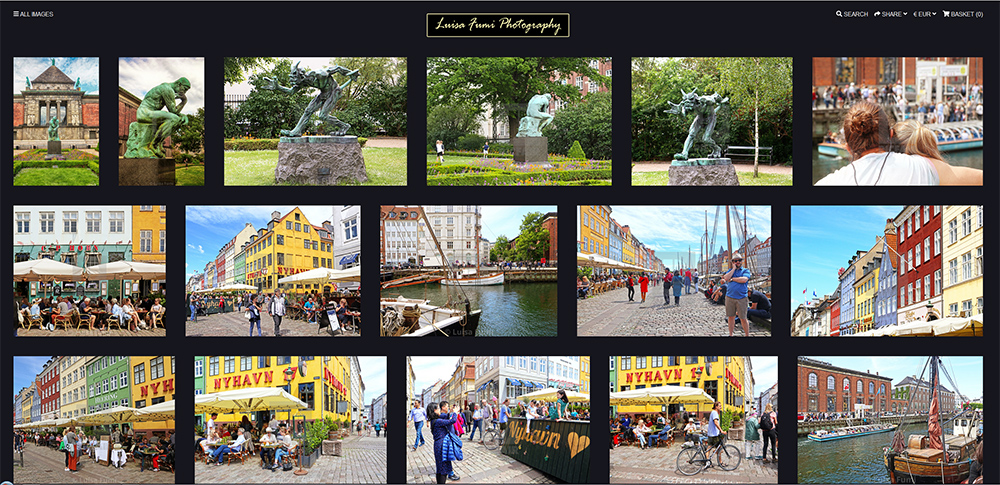
So be it: luisafumi-photography.com
The presentation of the images is very good, and I can (beside having an URL of my own by them):
– sell prints,
– make albums and feature one on the first page,
– have a local search engine,
– create a splash page with a picture I love
– add external links to the menu (to my blog here, to my other website vintage-nostalgia.com, etc.)
– have a personal watermark. I retained the Pifair standard one, very well thought and designed, also because I am happy to be there in excellent company, as I find the overall Picfair image quality astonishingly high.

Time will tell if such a decision will be fruitful – now it is to early to make a reliable forecast about the destiny of the photo market at all.

Just few days after my new Picfair installation I was rewarded with a pleasant surprise: my first print sale, my splash image! A good omen and a nice startup.

SPLASH-PICFAIR-600 by luisa fumi.

Microstock Armageddon?

luisa-photogr2-1000 by .

Find you niche(s)!

I fear that Shutterstock has given the final blow to the microstock photos market with their unilateral action, by reducing drastically the contributors royalties to 10 cents/picture – promising more for big amounts of uploads and sales, but resetting the contributor at the beginning of each year – that is, forcing her/him to start from scratch @10 cents/sale, and thus humiliating legions of outraged submitters.
And I also fear that this deliberate act is actually a farsighted move: the SS people must have realized that the time was ripe to grab as much as possible before going out of business.
Just look around: the websites offering high res images for free are rapidly growing and some of their pictures are really beautiful, also considering that today’s smartphones are growing better endowed than most photographers.

What to do now?
I’m thinking of two possibilities:

1. Business is business: to upload all of one’s images on all agencies that sell (if just a little) in exchange for a decent (if just a little) royalty, and to hope for the best.
Alas, there is a heavy drawback about it, tough: a couple of years ago I withdrew almost all my images belonging to a particular well-selling niche from the less profitable agencies. As it happens, it proved to be a blatantly fortunate manoeuver: my sales at Alamy and Adobe more than doubled immediately. And they keep growing.
This way I understood that I was my own cheap competitor. When 123RF contacted me on behalf of a customer about a deleted image of mine, I told them that I was really sorry and explained candidly my problem. Quite surprisingly they accepted my point of view and respected it.

2. To accept the change without moaning and make plans. To leave and to upload your images on the trustworthiest agencies, but to keep aside the best ones and find other more profitable ways to sell them.

Still I think that the idea of a personal stock agency is worth a thought or three anyway – no matter if self-hosted or not: there are several alternatives on the market and at least two of them are very affordable (I’ll tell about them in a next post).
It could turn into a precious show-window for the images you like too much to give them away cheap.

At this point it wouldn’t surprised me to witness a revival of many curated niches over the mass cauldron.
Since many years I’m not only a contributor, but on behalf of my web customers also a microstock buyer, and as such I’m perfectly aware that my behaviour doesn’t deviate much from the vast majority of buyers, who statistically give up after the second page the local search engines produce.
And what with the tenths of millions of images stored by the agencies? Dead, almost completely dead.

Nowadays selling microstock is like winning a prize at a cheap lottery called “search engines”: partially random, partially influenced by hidden rules and only marginally based on the actual, hard-labored keywording.

What’s the point of such zillions of dead images, when just a few thousands of high-quality pictures, if well presented and properly selected, could make a really huge difference?