How to sell stock images today

preamble: a professional photographer asked me some hints to sell stock images. I answered her privately. Then I thought that a slightly fleshed-up version of it might also deserve a little corner on my blog.

For decades now I’ve been looking for some magic formula to sell good pictures on the web, and if I had run into an effective one I wouldn’t hesitate to pass it to you. But, alas, that seems fated to stay a dream.
Then let’s put aside the dreams and face today’s reality, so that we can realistically adjust our targets and methods to it, thus sparing us the worst disappointments:

1 – nowadays (and for quite some time) just everyone is a photographer – or believes firmly that she or he is one, even if all they do is tap the screen and upload the picture. What they lack in skills is amply offset by the hi-tech electronics inside the chatter can.

2 – most of the audience – the buying audience – don’t appear very interested in the quality of the images they purchase. I sold at a comparatively high price and/or in impressive quantities pictures that, if not totally dull, were nothing exceptional, whereas a number of really beautiful ones are still there awaiting their first buyer.
An example?
prosecco & pecorino

This image is one of my bestsellers at Adobe with 280 sales until now (from .38 to 26.40 USD each) and keep selling. I am the first to admit that it is nothing special, even if the composition and the content is good.

3 – There seems to be no rationale for the criteria they use to choose which images to purchase – or if there’s one I failed to see it in the last 16 years.

4 – Whoever buys the images prefers the big agencies over the small individual seller, no matter the price, the quality or the professionalism of the agency, as long as it has a name big enough. Possibly (just a wild guess of mine) for they pay out of their client’s pocket, not of their own.

And still, despite such a bleak scenario, I keep making decent money by selling images on the web. How?

In the first place I put in the freezer my ambition to make money by selling art: for my most beautiful pictures I have a couple of private websites that produce a few sales and a lot of satisfaction.

Then I discarded the smallest agencies. Why? Let me explain: I think that Dreamstime is a quite fair agency, but it takes me 2 years to make the same amount I achieve in less than a week by Adobe. Moreover, I would be competing against myself.
Actually I’m selling pretty well at Alamy (the best for me), Adobe and Istock. I obviously discarded Shutterstock, leaving there (in my still open account) only a toilet paper still life.

toilet paper

As for the small agencies, I deleted most of my images there but left my account open: should the situation change I might reconsider coming back again. Except for the ones I really dislike: by them I deleted everything and disappeared in a puff of smoke (a name? Wirestock).
With this tactical approach I saw my income soar… well not enormously but significantly.

And I began listening to the old saying “when you go fishing put a worm on the hook: it’s the fish that must like it, not you” and uploading to the agencies mostly nice but quite ordinary pictures, the kind ordinary people would like and buy.

I hope this helps you rather than discourage you…

My first attempt with RUNWAY

This is my first attempt to make video with AI.

WOW! I tested RUNWAY (for now just the free version), starting on some Midjourney images of mine and doing my best to add some simple movement. Just for fun (the last famous words… šŸ™‚ ).
The results look pretty promising, – at least to me – although the free version doesn’t allow movies longer than a few seconds.

Here I used this image

and a quite generic prompt “(scuba floating gently away under water with fishes)”.

. Then I reversed the clip for I liked better the scuba coming in rather then fading out.


And here… voilĆ  Charon’s boat stuck in a hellish cave while the souls of the dead are waiting…


In this case I used the brush option to show where and which elements of the image should be involved in the motion: astounding! intuitive, quick and easy. Easier than by prompt.

The Krampus Parade

It was quite cool to recreate with Midjourney a Krampus night šŸ™‚

What is a Krampus?

It’s a big hairy creature, a blend of beast and human, with horns, a long pointed tongue, fangs, and a very convincing devilish look. The roots of the tradition date to an unspecified pre-christian era, from the European alpine regions.
Several centuries back the heathen Krampus folklore was engulfed into the Christmas tradition as a dark counterpart to St. Nicholas, to remind (mostly the children, but not only) of the possible effects of being naughty rather than nice.
Dozens of such ominous half-goat, half-demon creatures roam the streets during the Christmas season (5th-6th December) rattling chains and bells to warn or punish those who haven’t behaved properly (actually all the bystanders, not a bad assumption šŸ˜‰ ).
The Krampus parade annual event is really a spine-chilling and oddly fascinating show: it takes more than a while to realize that inside those sinister figures there are playful men that every now and then stop and take off their demonic horned heads to drink a beer or play with absolutely delighted children.

The dark and the wild

Have a look at my AI & I collection and enjoy the gothic artistic side of the Krampus depicted by flogging MidJourney long enough.
13 beautifully suggestive images – occasionally with a hint of humor,

The practical and the funny

If you want to have a look at the real side of the ‘Krampusses’ – to balance the macabre with the fun – just look at my editorial images of the “backstage” of the annual Krampus Run in Munich These are 100% real, live, no AI involved.

The participants take their Krampus get-ups very seriously and spend a lot of money throughout the year to bring the evilness of their creation to perfection: elaborated barbaric fur outfits, heavy artistically carved wooden masks, monstrous horns, long lolling tongues – and more, much more. It’s a great experience to watch those big friendly guys happy even if exhausted by the fatigue of wearing those incredibly heavy costumes, graciously posing for a selfie and accepting kindly the curiosity of the viewers.

As in so many other occurrences, here too the AI complements admirably a professionally used camera, the one siding with fiction, the other with reality. The conflict is so often in the eye of the beholder…

Senior Gym

Visual Journey, embracing Flexibility and Strength in the Golden Years
A new collection at Gameover’s Atelier exploring per images the benefits of physical activity for seniors:
Improved Flexibility
Enhanced Strength & Muscle Tone
Better Posture & Balance
Increased Bone Density
Boost in Cognitive Functions
Portraits created using advanced artificial intelligence algorithms privately generated, intensively post-processed by (human šŸ˜‰ ) hand and upscaled without losing resolution.

Flamenco!

Behold the exquisite allure of Flamenco dance captured through a collection of eight splendid images, now proudly included in my AI & I collection as a result of an effective collaboration between Midjourney 5.1 and me.
I found it quite challenging to pass on to Midjourney the vision I had in mind, but the outcomes were mesmerizing.
Then I devoted myself to a long and painstaking postprocessing to summon the enchantment, the frantic dynamics and the atmosphere that would permeate each and every image.
So pleased was I that I ask chatGPT for a poetic praise of the Flamenco the way Garcia Lorca would have written it. I liked it a lot šŸ˜€

En la tierra andaluza,
se escucha el sonido
del taconeo ardiente,
del zapateo encendido.

Es el baile flamenco,
la pasión hecha arte,
la emoción en movimiento,
el corazón que late.

Con vestidos de colores,
y mantones al viento,
las mujeres bailan,
con gracia y sentimiento.

Los hombres tocan la guitarra,
con maestría y pasión,
creando mĆŗsica que alienta,
la danza de corazón.

Y en el aire se siente,
el duende que hace vibrar,
esa danza que es poesĆ­a,
y que hace el alma soƱar.

”Olé! El flamenco es vida,
es el alma de EspaƱa,
es el fuego que nos quema,
y la pasión que nos llama.

(Federico Garcia GPT šŸ˜€ )

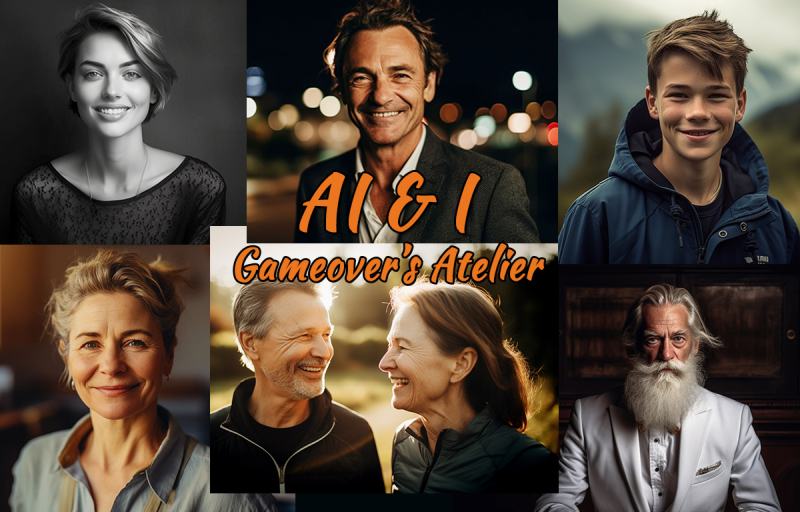
AI & I Lifestyle Portraits

Yes, I’ll admit that I felt a cold chill down my spine.
I’m pretty familiar with the ways of neural networks and as such I’m well aware that these portraits don’t depict any real person. No, they are artificially generated after processing zillions of human pictures to build up millions of ā€˜concepts’ about the way a human face should possibly look, and then by combining those concepts into always different images of non-existent people apparently having an own marked identity and personality.
But something within me wouldn’t listen to reason: they looked so incredibly real… thus in order to stifle once and for all that nasty inner voice I fed google with a number of them and asked it to look for similar ones online.
And… no match, nothing, zilch: those people simply don’t exist and never did. Period.


Which leads to a reflection:

according to the naysayers using an AI to generate images would infringe someone’s copyright, and using those images would be ā€œstealingā€ other people’s work.

Yet applying such gut feeling… opps, ā€˜reasoning’ to those AI-generated human portraits doesn’t look terribly realistic: there’s no style to be stolen (not to mention that a style cannot be copyrighted), and no one could ever claim that their facial features have been used without their consent. Who’s rights are being infringed?

I agree, it’s understandable that lifestyle photographers and models may fear for the continuity of their job, not unlike the draftsmen when the first Autocad was released decades ago; but the disappearance of the drafting board didn’t kill their profession, it just moved it one notch up. For professionals flexible enough the new tools won’t be the gibbet’s trapdoor, they’ll be a door open on plenty of new unexplored ways to express their creativity.

Prompt & postprocessing

It should also be remembered (for those who forgot it) that getting decent AI-generated images is not just a matter of snapping fingers or pushing a button, in the same way as taking a decent photograph is not just a matter of tapping the smartphone and uploading the pic to Shutterstock

Issuing the right prompt entails more than a pinch of ingenuity, experience and creativity, and getting the image the way you like needs a good deal of patient experimentation and very accurate postprocessing, just like a real photograph.

Speaking of postprocessing, let me tell you about a curious aspect of it: it isn’t just a matter of conferring a particular flair, light and atmosphere to the AI-generated images. While inspecting my images at 100% after upscaling, I was disappointed noticing that they looked like illustrations rather than as real pictures. To fix that I had to contrive a not-so-simple Photoshop action that took good care of the inconvenience, and now I’m satisfied.

The portrait collection

Hope you’ll like my AI & I ā€œportraitsā€.

I went for spontaneity and simplicity, no extreme fashion or makeup, just people like you and me and the ones we see while shopping.

Oh, I nearly fell desperately in love with the gentleman with silver beard and hair (in the lower right corner of the collage above). I took a dozen AI-snapshots of him, selected the best ones for you and kept the rest to myself. My husband is getting a little jealous and I think he’s growing a beard… šŸ˜‰

Midjourney V5 is here!

The new alpha Version of Midjourney V5 has been released.
No more distorted faces, no stray eyes, and even the finger count seems to be OK – about time!
How can you tell that this (above) isn’t a real photo? Well, there’s no “Vespa” logo on the young lady’s scooter… šŸ™‚
Such an astonishing perfection is almost disturbing and might pose some ethical problems – working on a blog article about them.


Occasionally though the perfection is, ahem… perfectible: here the photographic effect is also impressive, but the detective doesn’t seem to be much at ease with that gun. Maybe he’s a rookie… šŸ˜€
However his hat is very fiftyish and the car in the background is terribly realistic too.

AI: friend or foe? (5 of 5)

previous parts:
A very brief history of art: In the beginning…
A very brief history of art: growing up
A very brief history of art: today
A very brief history of art: fight them or join them?

A very brief history of art: where will it end?

Thus we’ll better cross off those ā€˜predictables’ that live on borrowed thoughts: to them it would make no difference whether a work is human- or AI-generated, and obviously decent AI works will sell cheaper than their human counterparts.
If we want something an AI can’t beat we should look for clients with a non-atrophic soul, a respectable culture and an independent mind of their own; comparatively rare as they can be, the humankind is still huge enough for them to constitute a respectable share of the market – anyway enough to support the real artists, if maybe not all those who tap the cellphone, upload the pic to Shutterstock and call it art.

Reaching such choosy, finicky, appreciative clients won’t be easy, and doing it alone looks pretty hopeless – the starving artist who tries to sell his great paintings on the sidewalk is a classic figure we’d rather avoid.
But the world hasn’t changed only for the worst: today we have an internet where many non-starving artists may join to offer their works to customers able to appreciate them. Or the same literate customers could gather and form a sort of very choosy ā€˜real art agency’ where only original, beautiful, unique works are accepted.

The brave new world

With a bit of luck there would be also some space left for the tap&upload ā€˜artists’: in order to supply the brave new microstock world the various AI’s will need to be fed with more and more new images, regardless of their quality.

OK, but…

… what if a particularly clever AI eventually manages to emulate a ā€˜soul’ of its own that a human cannot tell from a real one? Including attitudes, emotions and moods such as sadness, irony, anger, happiness, humor, enthusiasm, sarcasm and the like, in order to add a final touch of realism?

That would be an extended version of the famous Turing test, a philosophic minefield: if a machine succeeds convincing you (human) that you’re talking to another human being, then you should call it intelligent to all effects, like it or not.
You cannot pretend to play violin convincingly without mastering the art, right?

It’s pretty hard to swallow that much but, no matter how we may feel inside for reasons we ourselves cannot fathom, political correctness would demand that if an AI passes such a test we call it a human being: if we deserve equal treatment, respect and dignity regardless of our color, sex, origin, creed, mother tongue, intelligence, sexual orientation, shoe size and political affiliation, why should it matter if one is made of silicon chips and plastic rather than of flesh and bones?

THE END (so far…)

AI: friend or foe? (4 of 5)

previous parts:
A very brief history of art: In the beginning…
A very brief history of art: growing up
A very brief history of art: today

A very brief history of art: fight them or join them?

Yes, but how long will it last?
Hard to say: only six months ago one would have guffawed at the notion of a computer producing original creative images virtually indistinguishable from the ones made by a skilled artist. Now on that same notion we are crying aloud.
A machine has no soul but, if properly ā€˜educated’, it seems to be able to emulate pretty well one; by scanning thousands of human-made works it sort of ā€˜deduces’ what pleases us and imitates it plausibly enough. How long can take it to learn and imitate credibly also our newly found ā€˜human-only’ jobs?

That depends on the job, of course. Let’s be honest: when we paint, draw, write, sculpt or do anything else that we regard as human-only, we too use plenty of ready-made patterns we’re accustomed to – color combinations, common shapes, set phrases, easily detectable rules or identifiable styles… in the end only a small part of our work is really ours, all the rest is out-of-the-can.

It’s the way we assemble the out-of-the-can elements and merge them with our own ideas that makes the outcome unique.

Now, the AI has no ideas of its own; the originality of its work comes only from the input words we feed it with, most likely a little stirred by a random algorithm to prevent the machine from churning out identical outcomes from identical inputs.

Sadly enough though the same goes also for quite a number of people of flesh and bones: how many times did you hear ā€œMan, he’s so predictableā€¦ā€? How many people speak mostly (or only) in clichĆ©s? How many get their ideas, opinions, even beliefs mostly (or even only) from the community they live in, or from their favorite social?
I’m afraid that those people will be perfectly satisfied with the outcomes of an AI, no matter if it’s made only of out-of-the-can elements and a pinch of random.
Want a novel? Just enter
ā€œboy meets girl – parents oppose – girl runs away – boy follows her – rival appears – boy beats rival – happy ever after – Sugar Kissy styleā€,
upload it to www.romanticker.com *) and download a 300 pages bestseller that all the ā€˜predictables’ will buy eagerly. Just don’t tell them it’s AI-made, their social might not approve of it šŸ™‚

**)

*) don’t try it, it doesn’t exist – yet.
**) image created with Midjourney and made swooning enough with postprocessing, not based on real persons.

next part:
A very brief history of art (5 of 5): where will it end?

Gameover’s Atelier: AI+Human Collection

For some of months I’ve been privately experimenting with Midjourney, and I’m constantly witnessing an enthralling, almost incredible evolution. As I’m using it quite intensively (2638 images generated so far) I’ve reason to believe that I’m also partaking in its ā€˜training’ šŸ™‚

Self-awareness?

That’s a big word and IMO applying it to today’s AI would (still) be a gross overkill. However in those three months the improvement in composition and quality of the outcome were really astonishing – the ā€˜thing’ is definitely growing up and learning a lot!

As it may be expected, pretty often there’s plenty of post-processing and upscaling work to do and you end up with an image quite different from the original one. But not always. Sometimes all you need to do is to prompt the bot with the proper wording over and again until you like it, and then to touch up the final outcome just a little: in the end you find yourself thinking ā€œOMG, that’s exactly what I had in mind!ā€.

I’ve read a lot about millions (or billions) of images being ā€˜stolen’ from their creators to train the AI – implying that everyone should be entitled to the correspondent royalties. But is it really theft, or are those images just used as machine-learning to point the AI towards some kind of independent creativity?

I’d rather go with the latter, also in view of the incredibly fast evolution of Midjourney.

Just consider…

Think for a moment: when you take a pic of a cathedral do you really wonder if you should pay a royalty to the bishop, or maybe to the architect who designed it? And does such a thought bother you when you photograph the work of a painter from the past, or a car whose logo you’ll remove in the post-processing, or someone on the street who agrees to it with a smile?

Now don’t you tell me that you aren’t drawing inspiration from somewhere when you create a work of your own – maybe from dozens of watermarked images, or from the pictures on an ancient book, or from a scene you just saw and found worth using, or, or…

Drawing inspiration is a human quality and this sort of empathy is the very base of creativity: you create from the world that surrounds you – no world, no creation.

I’ll agree, it’s quite disconcerting, even disturbing, to apply such concepts to a non-human entity, a mere ā€˜thing’ made of metal and silicon chips. But we shouldn’t forget that this ā€˜thing’ has been designed and made by humans, and humans are those who use it as the tool it is.

Setting aside philosophy, since this kind of images of mine were received well by Adobe and started selling promisingly I selected some and uploaded them to my Gameover’s Atelier. For the time being I limited my choice to simple subjects that I however find attractive and looked at from an unusual point of view. Should anyone be interested, they can be purchased pretty cheap – outrageously cheap indeed (50% down!) if bought before coming Christmas šŸ˜€

I had plenty of fun choosing and commenting them, and I’ll keep adding more and more every day.

Note: the opening image on top was initially created by me with Midjourney’s bot and carefully touched up. The Florentine merchant depicted there doesn’t exist and never did; nor can you buy a “Pear Computer”, to the best of my knowledge šŸ™‚