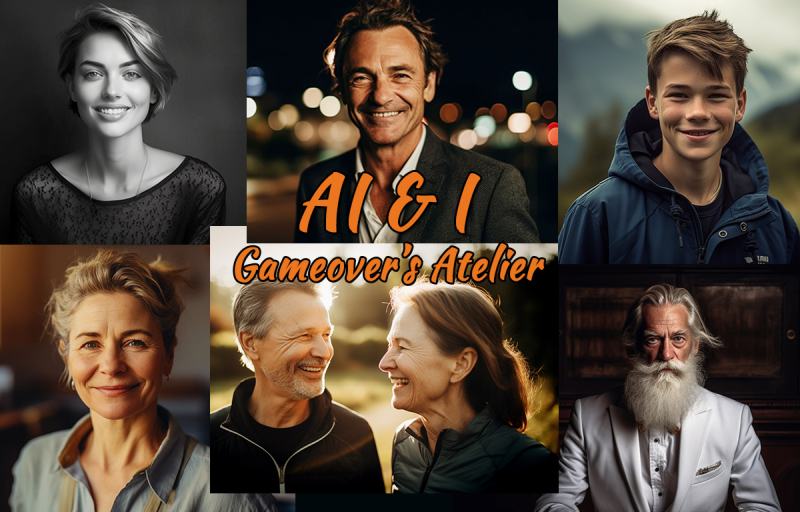
AI & I Lifestyle Portraits

Yes, I’ll admit that I felt a cold chill down my spine.
I’m pretty familiar with the ways of neural networks and as such I’m well aware that these portraits don’t depict any real person. No, they are artificially generated after processing zillions of human pictures to build up millions of ‘concepts’ about the way a human face should possibly look, and then by combining those concepts into always different images of non-existent people apparently having an own marked identity and personality.
But something within me wouldn’t listen to reason: they looked so incredibly real… thus in order to stifle once and for all that nasty inner voice I fed google with a number of them and asked it to look for similar ones online.
And… no match, nothing, zilch: those people simply don’t exist and never did. Period.


Which leads to a reflection:

according to the naysayers using an AI to generate images would infringe someone’s copyright, and using those images would be “stealing” other people’s work.

Yet applying such gut feeling… opps, ‘reasoning’ to those AI-generated human portraits doesn’t look terribly realistic: there’s no style to be stolen (not to mention that a style cannot be copyrighted), and no one could ever claim that their facial features have been used without their consent. Who’s rights are being infringed?

I agree, it’s understandable that lifestyle photographers and models may fear for the continuity of their job, not unlike the draftsmen when the first Autocad was released decades ago; but the disappearance of the drafting board didn’t kill their profession, it just moved it one notch up. For professionals flexible enough the new tools won’t be the gibbet’s trapdoor, they’ll be a door open on plenty of new unexplored ways to express their creativity.

Prompt & postprocessing

It should also be remembered (for those who forgot it) that getting decent AI-generated images is not just a matter of snapping fingers or pushing a button, in the same way as taking a decent photograph is not just a matter of tapping the smartphone and uploading the pic to Shutterstock

Issuing the right prompt entails more than a pinch of ingenuity, experience and creativity, and getting the image the way you like needs a good deal of patient experimentation and very accurate postprocessing, just like a real photograph.

Speaking of postprocessing, let me tell you about a curious aspect of it: it isn’t just a matter of conferring a particular flair, light and atmosphere to the AI-generated images. While inspecting my images at 100% after upscaling, I was disappointed noticing that they looked like illustrations rather than as real pictures. To fix that I had to contrive a not-so-simple Photoshop action that took good care of the inconvenience, and now I’m satisfied.

The portrait collection

Hope you’ll like my AI & I “portraits”.

I went for spontaneity and simplicity, no extreme fashion or makeup, just people like you and me and the ones we see while shopping.

Oh, I nearly fell desperately in love with the gentleman with silver beard and hair (in the lower right corner of the collage above). I took a dozen AI-snapshots of him, selected the best ones for you and kept the rest to myself. My husband is getting a little jealous and I think he’s growing a beard… 😉

Midjourney V5 is here!

The new alpha Version of Midjourney V5 has been released.
No more distorted faces, no stray eyes, and even the finger count seems to be OK – about time!
How can you tell that this (above) isn’t a real photo? Well, there’s no “Vespa” logo on the young lady’s scooter… 🙂
Such an astonishing perfection is almost disturbing and might pose some ethical problems – working on a blog article about them.


Occasionally though the perfection is, ahem… perfectible: here the photographic effect is also impressive, but the detective doesn’t seem to be much at ease with that gun. Maybe he’s a rookie… 😀
However his hat is very fiftyish and the car in the background is terribly realistic too.

AI: friend or foe? (5 of 5)

previous parts:
A very brief history of art: In the beginning…
A very brief history of art: growing up
A very brief history of art: today
A very brief history of art: fight them or join them?

A very brief history of art: where will it end?

Thus we’ll better cross off those ‘predictables’ that live on borrowed thoughts: to them it would make no difference whether a work is human- or AI-generated, and obviously decent AI works will sell cheaper than their human counterparts.
If we want something an AI can’t beat we should look for clients with a non-atrophic soul, a respectable culture and an independent mind of their own; comparatively rare as they can be, the humankind is still huge enough for them to constitute a respectable share of the market – anyway enough to support the real artists, if maybe not all those who tap the cellphone, upload the pic to Shutterstock and call it art.

Reaching such choosy, finicky, appreciative clients won’t be easy, and doing it alone looks pretty hopeless – the starving artist who tries to sell his great paintings on the sidewalk is a classic figure we’d rather avoid.
But the world hasn’t changed only for the worst: today we have an internet where many non-starving artists may join to offer their works to customers able to appreciate them. Or the same literate customers could gather and form a sort of very choosy ‘real art agency’ where only original, beautiful, unique works are accepted.

The brave new world

With a bit of luck there would be also some space left for the tap&upload ‘artists’: in order to supply the brave new microstock world the various AI’s will need to be fed with more and more new images, regardless of their quality.

OK, but…

… what if a particularly clever AI eventually manages to emulate a ‘soul’ of its own that a human cannot tell from a real one? Including attitudes, emotions and moods such as sadness, irony, anger, happiness, humor, enthusiasm, sarcasm and the like, in order to add a final touch of realism?

That would be an extended version of the famous Turing test, a philosophic minefield: if a machine succeeds convincing you (human) that you’re talking to another human being, then you should call it intelligent to all effects, like it or not.
You cannot pretend to play violin convincingly without mastering the art, right?

It’s pretty hard to swallow that much but, no matter how we may feel inside for reasons we ourselves cannot fathom, political correctness would demand that if an AI passes such a test we call it a human being: if we deserve equal treatment, respect and dignity regardless of our color, sex, origin, creed, mother tongue, intelligence, sexual orientation, shoe size and political affiliation, why should it matter if one is made of silicon chips and plastic rather than of flesh and bones?

THE END (so far…)

AI: friend or foe? (2 of 5)

previous part:
A very brief history of art: In the beginning…

A very brief history of art: growing up

About six centuries ago an irresponsible Johannes Gutenberg invented the movable type printing, thus depriving thousands of guileless monks of the job they had devoted their entire life to. The catastrophe spread like wildfire: holy and less holy pieces of literature escaped the watchful hands of the Church and started spreading around information, concepts and ideas that bishops and kings would rather have kept confidential, thus pulling the cork off the Renaissance…
Just imagine all those monks and abbots groaning and moaning about the death of the art of calligraphy and as such of the literature as they knew it…

yet surprisingly enough Gutenberg’s felony didn’t kill the literature at all; it just stripped off its aura of holy and arcane and focused it more on the contents than on the form.

In the following centuries the worries raised by scientific and technological progress intensified exponentially: chemistry stole the work from alchemists, medicine from witch doctors and healers, the steam engine from horse breeders, physics and astronomy from theologians, the mechanical loom from weavers (remember the Luddites?), the internal combustion engine from the steam engine… the list could go on for quite a while.

Then after WWII the embers of a science that for a couple of centuries had been discreetly growing in the background without affecting much people’s life, ignited the fuse and the situation exploded: new technologies started popping up like mushrooms, newer technologies replaced them in a matter of a few years (or even months), the world began changing at an impressive speed.

Believe it or not, still in 1962 a computer was a human being, most often a woman, who performed a set of boring repetitive calculation manually or sometimes with the help of a few rattling mechanical gadgets. Less than four years later a bloom of electronic computers – bulky, clumsy, primitive but then regarded as lightning-fast – was already spreading on the world markets and stealing the job from innumerable grudging accountants and bookkeepers.

And today’s world was born.

next part:
A very brief history of art (3 of 5): today

AI: friend or foe? (1 of 5)

A very brief history of art: In the beginning…

The following article is the result of a bloody fight between myself and a guy I married a few centuries ago. In the end we had to acknowledge that our points of view were virtually identical but neither of us wanted to admit it. So we reached a compromise: he wrote the article, I deleted the most politically incorrect remarks, he rewrote them in a milder form, I got a bunch of roses as an apology, he got a fine dinner. Occasionally marriage can be a great thing… 🙂

Lately I’ve read a lot of posts wailing, grumbling and moaning about the latest developments of AI potentially stealing the job from all kind of artists. Some of them looked reasonably well-informed, others gave the impression of a strong emotional position not really supported by any actual experience or direct knowledge.

Be it as it may, I think they could be right: if things keep going the way they are, plenty of ‘artists’ will inevitably lose their jobs as soon as their customers learn how to order a piece of art directly at the source, a skilled and most likely way cheaper AI. It’s just a matter of time, but the trend looks pretty clear.

However this is not the first time such a tragedy occurs: about four millennia ago some ruthless guy invented the potter’s wheel without giving a thought to the countless people his devilish invention would leave jobless: soon all those skilled artists capable of making a nicely round vase in less than a week saw their customers fade away and go buy for a ludicrously low price a perfectly round vase made in a quarter of an hour with the new gadget.
Still someone – probably a jobless artist – must have considered that the concept of ‘art’ could not be constrained to the way a beautiful thing is made: it might as well extend to the feelings such a beautiful thing elicits in us humans. And he (or she) started decorating those outrageously round vases with paintings that survived all the way to us, beautiful pieces of art having very little to do with the roundness of the support.

It’s sort of suggestive that for several millennia the Greek word τέχνη (téchne) has ever meant ‘art’ exactly in the sense we attach to this word today. Will that mean that in the course of time all arts are bound to get standardized and flattened into technology? I don’t know, I’m just thinking of another word, ‘artificial’…

Nor is this an isolated case…

next part:
A very brief history of art (2 of 5): growing up

Gameover’s Atelier: AI+Human Collection

For some of months I’ve been privately experimenting with Midjourney, and I’m constantly witnessing an enthralling, almost incredible evolution. As I’m using it quite intensively (2638 images generated so far) I’ve reason to believe that I’m also partaking in its ‘training’ 🙂

Self-awareness?

That’s a big word and IMO applying it to today’s AI would (still) be a gross overkill. However in those three months the improvement in composition and quality of the outcome were really astonishing – the ‘thing’ is definitely growing up and learning a lot!

As it may be expected, pretty often there’s plenty of post-processing and upscaling work to do and you end up with an image quite different from the original one. But not always. Sometimes all you need to do is to prompt the bot with the proper wording over and again until you like it, and then to touch up the final outcome just a little: in the end you find yourself thinking “OMG, that’s exactly what I had in mind!”.

I’ve read a lot about millions (or billions) of images being ‘stolen’ from their creators to train the AI – implying that everyone should be entitled to the correspondent royalties. But is it really theft, or are those images just used as machine-learning to point the AI towards some kind of independent creativity?

I’d rather go with the latter, also in view of the incredibly fast evolution of Midjourney.

Just consider…

Think for a moment: when you take a pic of a cathedral do you really wonder if you should pay a royalty to the bishop, or maybe to the architect who designed it? And does such a thought bother you when you photograph the work of a painter from the past, or a car whose logo you’ll remove in the post-processing, or someone on the street who agrees to it with a smile?

Now don’t you tell me that you aren’t drawing inspiration from somewhere when you create a work of your own – maybe from dozens of watermarked images, or from the pictures on an ancient book, or from a scene you just saw and found worth using, or, or…

Drawing inspiration is a human quality and this sort of empathy is the very base of creativity: you create from the world that surrounds you – no world, no creation.

I’ll agree, it’s quite disconcerting, even disturbing, to apply such concepts to a non-human entity, a mere ‘thing’ made of metal and silicon chips. But we shouldn’t forget that this ‘thing’ has been designed and made by humans, and humans are those who use it as the tool it is.

Setting aside philosophy, since this kind of images of mine were received well by Adobe and started selling promisingly I selected some and uploaded them to my Gameover’s Atelier. For the time being I limited my choice to simple subjects that I however find attractive and looked at from an unusual point of view. Should anyone be interested, they can be purchased pretty cheap – outrageously cheap indeed (50% down!) if bought before coming Christmas 😀

I had plenty of fun choosing and commenting them, and I’ll keep adding more and more every day.

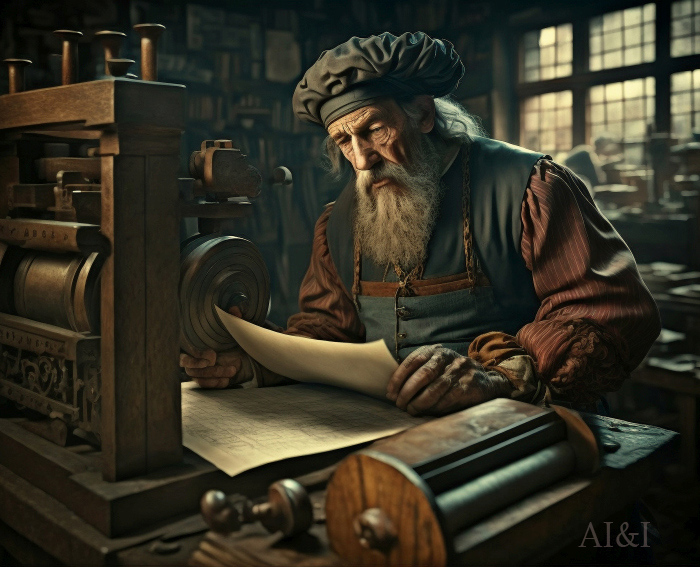
Note: the opening image on top was initially created by me with Midjourney’s bot and carefully touched up. The Florentine merchant depicted there doesn’t exist and never did; nor can you buy a “Pear Computer”, to the best of my knowledge 🙂

New beta engine at Midjourney

–v 4, quite impressive!

The best approximation to the usual mess at my husband’s team lab 😀 😀

Both images are generated by Midjourney only through text and parameters.
The outcome is surprisingly quite familiar to me: it feels like to be there.

Sorry folks, working with AI is immensely creative and a big source of fun.

De profundis

Paddle steamer in the storm by copyright luisa fumi.

It takes so little to kill the last glimmer of hope… I complained to Alamy about their mass-few-¢-sale of this month, and in reply I got this :

Hi Luisa,
Thanks for your email. I can see that these sales are through our distribution scheme. Which you are opted in for.
Our Distribution scheme is optional and under the section of your account titled “Additional Revenue Option”. As the title suggests it’s an opportunity to earn additional revenue through territories that Alamy doesn’t quite reach with direct sales. Every year our Distribution scheme returns a sizable 15% of our total revenue and so we’d recommend being part of it.
You can only opt out or remove countries in April of every year; this is so we can give our distributors a consistent collection.

Kind regards,
Chantelle

(note: I opted out from their ‘Novel use’ option last April 1st)

Let’s brush off the tiny coat of perfunctory politeness and have a closer look at the gist:

  • So I’m “opted in for”: did I opt in or was I opted in? I don’t remember having checked a box “feel free to sell my images for a few pennies and give me a minute fraction of that”.
  • If their Distribution scheme returns “a sizable 15% of their total revenue”, how many millions of images should they sell on the ‘miserable’ market to make 2¢ for the distributor, 2¢ for themselves and 1¢ for me, and still have a decent income?
    The 22 images of mine they undersold this way got them a total of $1.55 and a mightily irritated contributor about to abandon ship. Perhaps the time has come to move the rampant yuppie who had the Great Idea to the cleaning team.
  • So nice that I can opt out of such an economical disaster in April of every year, indeed. It would be even nicer though to know what exactly one has to opt out of in order to prevent one’s images from being given away like confetti.

“Fair play” has many opposites, and nowadays keeping the rules where nobody sees them has become a very popular one.

There is little doubt left, they definitely are shutterstocking. It’s damn sad to see an agency that used to have fair play as their flagship sink this low 🙁

GRASP ALL, LOOSE ALL

scrooge by .

Old proverbs contain plenty of ageless wisdom. If only people noticed this timely…

Unfortunately though the top-level managers of the microstock agencies seem to be too busy to devote their valuable time to such menial thoughts. Rumors have it that sooner or later, while watching complacently the increasing revenues, a brilliant notion pops out between some rosy-cheeked executive’s ears: “Why should we leave so much money in the hands of the morons that hand us their pictures? We have the market, we have zillions of well-selling images, we dictate the rules.

We all know where that leads: it’s the so-called “Shutterstock effect”. Curtail drastically the contributors’ shares, sell lots of images at bargain prices, give to the beggars their two cents, ignore the chorus of moans, anger and insults that raises from the rabble, see your income grow, shake hands with the colleagues, I’m a genius!

And then, after a few months, the backlash: many contributors feel cheated or even insulted and close their accounts, many more delete their best pictures leaving behind just crap a blind man wouldn’t buy, the incoming flow of images drops to a trickle, the buyers notice the drop in quality and go buy elsewhere, the income curve falls miserably (dammit, maybe with some Viagra…).
And eventually the friendly suggestion “you better start looking for a new job”. But then it’s too late, the damage is done.

Sad as it is, now it appears to be Alamy’s turn. In the last days, without warning or asking for an OK, they surprised the contributors world by selling off a large number of pictures for a few cents, and those who demanded an explanation whatsoever bumped their heads against a pretty long local holiday – no one there to reply, what a coincidence!
One could hope that it’s just a misunderstanding of sorts, perhaps a glitch in the software or a silly human error, but the symptoms are all too clear, and the suspicion that Alamy is shutterstocking is overwhelming.

That’s quite a shock indeed: not long ago they still had a spotless reputation as an agency that cared for the contributor’s satisfactions, paid reasonably fair shares, and provided good help when needed. More than a little demanding perhaps, if you think of the ordeal of keywording it adequately, but you cannot expect such a high-level agency to accept just any picture: they sell excellent quality and are entitled to demanding it.
They are my agency, we do a good job together… good old days? 🙁

Where will all this end? Hard to say that without a top-grade crystal ball and some powerful psi powers. However, judging by the microstock market trend in the last couple of years, a reasonable modicum of pessimism would suggest that most of the major microstock agencies will slowly (or even not so slowly) collapse under the weight of their own greed.

The scenario we could expect in a near future might show us two or three large surviving microstock agencies selling mediocre images very cheap by the ton on behalf of countless grumbling but resigned private contributors, a few ad-supported artistic websites selling very little, the usual lot of websites offering as “windows backgrounds” good images for free (but for personal use only).
And, with a bit of luck, a constellation of sites owned, managed and constantly fed by skilled photographers and graphic artists offering directly to the buyer very high quality images at a fair price, no bloodsucker share included.

If you want the best apples at a decent price, go knock directly at the farmer’s door…:-D

Two book covers at Arcangel!

book-covers by .

It was quite a surprise. Last week out of the blue Arcangel sent me an email asking for my billing data as I sold two book covers. In the following communication I learned all the details about the books.
I looked for them online, nothing yet. Anyway here are the images:

My account at Arcangel: 97 images (2 in keywording), an approval rate of 29%, a hard work to get tuned with the right mood in order to produce an approved image.

Okay, I can do more and apply more diligently 🙂

A big thank to Alex Rotenberg who on his brutally honest blog recommends to apply to Arcangel!