Microstock Armageddon?

luisa-photogr2-1000 by .

Find you niche(s)!

I fear that Shutterstock has given the final blow to the microstock photos market with their unilateral action, by reducing drastically the contributors royalties to 10 cents/picture – promising more for big amounts of uploads and sales, but resetting the contributor at the beginning of each year – that is, forcing her/him to start from scratch @10 cents/sale, and thus humiliating legions of outraged submitters.
And I also fear that this deliberate act is actually a farsighted move: the SS people must have realized that the time was ripe to grab as much as possible before going out of business.
Just look around: the websites offering high res images for free are rapidly growing and some of their pictures are really beautiful, also considering that today’s smartphones are growing better endowed than most photographers.

What to do now?
I’m thinking of two possibilities:

1. Business is business: to upload all of one’s images on all agencies that sell (if just a little) in exchange for a decent (if just a little) royalty, and to hope for the best.
Alas, there is a heavy drawback about it, tough: a couple of years ago I withdrew almost all my images belonging to a particular well-selling niche from the less profitable agencies. As it happens, it proved to be a blatantly fortunate manoeuver: my sales at Alamy and Adobe more than doubled immediately. And they keep growing.
This way I understood that I was my own cheap competitor. When 123RF contacted me on behalf of a customer about a deleted image of mine, I told them that I was really sorry and explained candidly my problem. Quite surprisingly they accepted my point of view and respected it.

2. To accept the change without moaning and make plans. To leave and to upload your images on the trustworthiest agencies, but to keep aside the best ones and find other more profitable ways to sell them.

Still I think that the idea of a personal stock agency is worth a thought or three anyway – no matter if self-hosted or not: there are several alternatives on the market and at least two of them are very affordable (I’ll tell about them in a next post).
It could turn into a precious show-window for the images you like too much to give them away cheap.

At this point it wouldn’t surprised me to witness a revival of many curated niches over the mass cauldron.
Since many years I’m not only a contributor, but on behalf of my web customers also a microstock buyer, and as such I’m perfectly aware that my behaviour doesn’t deviate much from the vast majority of buyers, who statistically give up after the second page the local search engines produce.
And what with the tenths of millions of images stored by the agencies? Dead, almost completely dead.

Nowadays selling microstock is like winning a prize at a cheap lottery called “search engines”: partially random, partially influenced by hidden rules and only marginally based on the actual, hard-labored keywording.

What’s the point of such zillions of dead images, when just a few thousands of high-quality pictures, if well presented and properly selected, could make a really huge difference?

A pebble in the pond: a free Artists’ Marketplace

stock3 by .

For nearly a month (since the infamous 1st of June) a couple of disquieting questions have been bouncing back and forth within my skull:
– what are we to do if/when the other agencies follow Shutterstock’s despicable example and start treating their contributors like beggars?
– How come a fair agency like Picfair appears to sell nearly nothing even though they offer such awfully great pictures?

I do know all too well what it’s like to set up a photostock agency – I did it. Once you solve the technical problems (quite a hard cliff themselves) and get it to run fine, you find out to your dismay that keeping it up and running – server fees, updating, de-hacking, automation, you name it – is way more expensive (at least in time) than you optimistically thought when you started.

No, I don’t really think that setting up a new agency – with so many small ones out there struggling to survive – would be a solution. What we need is a new concept, something that would entice anyone who needs one or more images having specific requirements. The cue came from Alex Rotenberg as he told us how a customer, unable to find his images on Shutterstock any longer, got directly in touch with him.

So why not to put in contact clients and contributors, thus bypassing the agencies?
All it would take would be a surprisingly cheap and simple no-profit site, a sort of artists’ cooperative dedicated to illustrations, photos and video clips, where potential clients may freely ask for images having some specific features. Their requests appear on a board and get immediately sent per E-mail to all photographers who subscribed (for free).
A mother knows her baby, a photographer knows his/her images: the one who has an image that may satisfy the client (say, a kid playing in a puddle) replies uploading ASAP one or more watermarked images onto a page that only the client may access.

That would be really big news: a thoughtful human response, no AI at all, no 300 pictures of the same lonely puddle in the park taken from 300 different angles. And no time wasted on keywords ( do we all loathe them!)

As far as prices are concerned, that’s all to be seen: fixed price, normal and premium, private negotiation… a matter of taste. However the cooperative rules must be simple and clear, and accepted by all subscribers; that’s important, the one who doesn’t play fair gets kicked out without ceremony.
The site would be extremely simple – though attractive – and wouldn’t require any special server performances, or large amounts of memory, or special skills to run it. The only costs would be:

  • annual server rent (not much).
  • software maintenance (not much if regularly performed, but it must be done weekly to keep the software up to date and to prevent possible undue intrusions, malware and hacking).
  • start-up software development and further expansions if the initiative is successful (affordable).

No commission on sales – we’re talking of a no-profit initiative and this way it shall stay, lest greed creeps in and shatters(tocks) it to crumbles 🙂

The expenditures above would be covered by all subscribers after their first sale; if some 1000 – 1500 artists gather and join, it would be a matter of a few $ each yearly – transparent management, all expenditures publicly documented, no hidden costs.

Of course there should be a page telling the cooperative’s history and its goals, with a nice name (how about “Shutterstock’s castaways”?) and some well-groomed galleries of monographic pictures about current topics, something like the Photocase’s ones.

Maximum publicity to all successful sales on the site.
No a-priori exclusive, though it may be individually agreed with the client case by case.

All the above should obviously be discussed in detail once (if) this initiative takes shape and color. Mine is just a stone I’m throwing in the pond, let’s see now if it makes any waves…

Life at corona virus time

FOUTAIN-s by .

Strange days now, at corona virus time. My web job runs as usual but I find more time to rediscover the nature and the apple blossoms: the spring air is crystal clear and I enjoy immensely my bicycle tours around, appreciating what is often taken for granted.
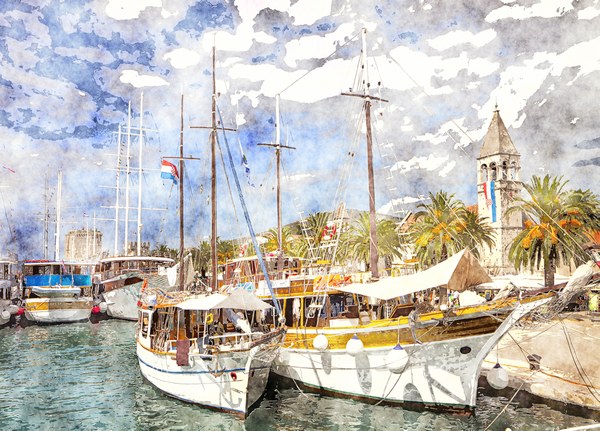
I also took the opportunity of revisiting my local shoots and processing some of them as watercolors. It is a loving tribute to this little university town with a healthy rural flair, so near at a magnificent big city like Munich.

Stock images: is it time now for a drastic change?

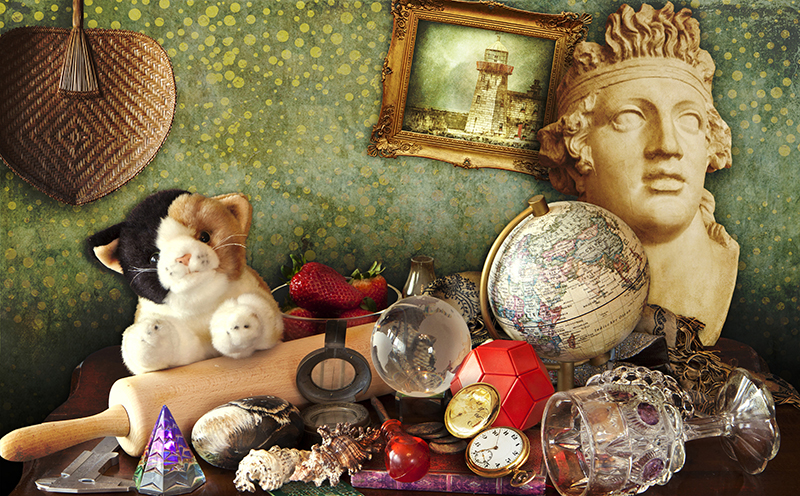
Mishmash objects with statue by Luisa Fumi.

The state of the art

Just to feel the pulse and the vibe of the moment, I visit pretty often the wailing wall, a site well known to the photographers that sell images through the microstock agencies. Most of what I read there is mournful whining about the professional degradation and the brutal royalty cuts. Nothing constructive.

Due mostly to the steadily improving quality of cameras and smartphones, the images market is flooded by offers ranging from fair to excellent, a flood swelling like wildfire. The stock agencies, no fools, take full advantage of the situation by constantly shrinking the royalies – offer and demand, inevitably. A tough competition is going on too among the agencies themselves, and not surprisingly the smallest ones succumb.

What’s the use of 100 millions of images?

One microstock agency can count on tens of millions of images (at least). But how could a customer find his way through them all?
How will customers get to the “right” image they are looking for? According to statistics, most of the users while searching give up after the first page, and very few clench their teeth and hold out up to page three.
Rumors have it that the stock agencies, in order to offer a different image variety for the same search, sort them part random, part according to other criteria adjusted and twitched from time to time

I’ve been wondering long if it was worth wasting so much time and effort on the keywording ordeal, by far the most boring and time consuming task of image processing, if the agencies use just a small part of it. And above all: what’s the point for an agency to collect zillions of images when people give up searching after a few of them?
I’m smelling here another crisis looming in the air.

A possible way out?

Now it could be really the right time to reinvent the personal website where one can sell images without the support (?) of an agency.
I am not talking about a website meant to sell generic images the way small agencies do – and are now going through difficult times.
No, I’m thinking of a monographic website to offer many thousands of images focused on a theme of general interest or social relevance.
A well designed site, cleverly divided in sub-galleries, with an own shop. Something very user-friendly that a visitor looking for a picture of sport, touristic European regions, vegan lifestyle, sustainable energies, rock concerts, steampunk art, you name it… could easily navigate almost instinctively.
Perhaps also supported by a blog to make it more lively and interesting.

Think of your passions, of what you mostly love to shoot: in your (digital) drawer you’ll certainly find many thousands of images on the subject. 2000 to 4000 of them could be a good start for such a website.

Like this the awfully boring and demanding work of keywording them all would not go wasted: extracted as page tags, the keywords would be used by Google or duckduckgo to locate exactly your pictures. Take my word for it, I tried it on my own skin and it works 😀

Upon a second thought, why just one website? Along the same lines you could create several others centered on different themes – as many as your interests.
Cheer up: we don’t need million of visitors, nor to spend a fortune on online ads, while we can afford a better alternative and thus pocket the whole loot rather than just a minuscule slice of it.

stock by .

The new supernova over Munich, editorial photos

Inauguration of the ESO (European Southern Observatory) Supernova Planetarium & Visitor Centre near the Eso headquarters in Garching near Munich, Germany

GARCHING, GERMANY - APRIL 27, 2018  The new Supernova Planetarium of ESO (European Southern Observatory) opens to the public

A new great attraction in Munich!
Supernova provides an immersive experience in astronomy and technology and – I would remark – lot of fun with interactive gadgets and virtual reality.
Learn the stars, the new projects and the history of universe on colorful boards written with dedication and full of amazing images.

GARCHING, GERMANY - APRIL 27, 2018  The new Supernova Planetarium of ESO (European Southern Observatory) opens to the public

Digital art with watercolor filters (EN)

I have begun to play with Photoshop artistic filters for fun.
Adjusting the parameters, some results are remarkable: the starting point is always a shot of mine, but the overall feeling changes.

Not all the images are suitable for this kind of treatment, but some are really enhanced by the watercolor effect:


They are accepted by Shutterstock as illustrations and they are selling!

Editorial images: spring flea market (EN)

Spring in Bavaria is the best time to visit flea markets.
The season begins with the biggest of all, the Riesenflomarkt in Munich at the same location of the Oktoberfest in autumn.
A big flea festival reserved only to private sellers, about 2000 stands just for one day of bargains.

Munich, collectible objects, home decorations, dishware and lamps on sell at the open air giant flea market
Munich, vintage movie posters and clothing on sell at the open air giant flea market
Munich, great choice of classical and modern guitars on sell at  open air giant flea market

Fancy a cowbell? Great choice here!

Riesenflomarkt in Munich, spring flea market

… or a trophy for your drawing room?

Munich, ibex head with horns as taxidermic trophy on sell at the open air giant flea market

I always find something to buy: ancient books, coffee cups and absolute useless trinkets that I cannot leave there, because they are telling me a story.
After this shopping ordeal, you can have a beer and a merry-go-round at the nearby spring Festival!

Munich, spring festival

Editorial images: the march of Science, Munich April 22 (EN)

The calendar read spring but the weather in Munich seemed to differ, thus I feared that a lot of people would desert the march and look for something cozier to do. But I was wrong: Karlplatz was full of merry people, who turned this meeting in a sort of civil festival.

All signs were clever, funny and appropriate:

why science? because it works, bitches
make science great again!
don't mess with science, we have laser
the best, typical Bavarian: NO SCIENCE, NO BEER !
NO SCIENCE, NO BEER !

the participants spoke in a calm and cool matter-of-factly tone to an utterly attentive audience. Then the march: first time in my life I see such a march stop on red traffic lights – apparently science and civilization walk hand-in-hand!

stop at traffic light

The gloomy side:

is it really worth the while to demonstrate against “alternative sciences” (alas, nowadays calling them “superstitions” wouldn’t be politically correct), or against “alternative facts” ( calling them “blatant lies” would be risky)?
Yes, I definitely believe it’s worth the while.

If we don’t, tomorrow we might have to demonstrate against “alternative honesty” or “alternative democracy”, and end up in a jail if we call them with their true names.

fakt not fake

I’m persuaded that we must remember constantly that the independence of science from politics, superstition and bigotry is an essential factor to the welfare of society and humankind, and that the survival of a millennial culture depends entirely on it.