Flamenco!

Behold the exquisite allure of Flamenco dance captured through a collection of eight splendid images, now proudly included in my AI & I collection as a result of an effective collaboration between Midjourney 5.1 and me.
I found it quite challenging to pass on to Midjourney the vision I had in mind, but the outcomes were mesmerizing.
Then I devoted myself to a long and painstaking postprocessing to summon the enchantment, the frantic dynamics and the atmosphere that would permeate each and every image.
So pleased was I that I ask chatGPT for a poetic praise of the Flamenco the way Garcia Lorca would have written it. I liked it a lot 😀

En la tierra andaluza,
se escucha el sonido
del taconeo ardiente,
del zapateo encendido.

Es el baile flamenco,
la pasión hecha arte,
la emoción en movimiento,
el corazón que late.

Con vestidos de colores,
y mantones al viento,
las mujeres bailan,
con gracia y sentimiento.

Los hombres tocan la guitarra,
con maestría y pasión,
creando música que alienta,
la danza de corazón.

Y en el aire se siente,
el duende que hace vibrar,
esa danza que es poesía,
y que hace el alma soñar.

¡Olé! El flamenco es vida,
es el alma de España,
es el fuego que nos quema,
y la pasión que nos llama.

(Federico Garcia GPT 😀 )

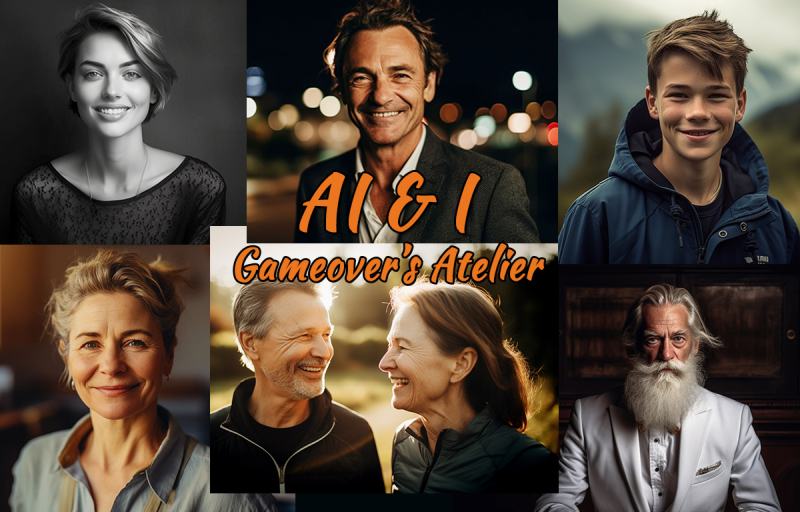
AI & I Lifestyle Portraits

Yes, I’ll admit that I felt a cold chill down my spine.
I’m pretty familiar with the ways of neural networks and as such I’m well aware that these portraits don’t depict any real person. No, they are artificially generated after processing zillions of human pictures to build up millions of ‘concepts’ about the way a human face should possibly look, and then by combining those concepts into always different images of non-existent people apparently having an own marked identity and personality.
But something within me wouldn’t listen to reason: they looked so incredibly real… thus in order to stifle once and for all that nasty inner voice I fed google with a number of them and asked it to look for similar ones online.
And… no match, nothing, zilch: those people simply don’t exist and never did. Period.


Which leads to a reflection:

according to the naysayers using an AI to generate images would infringe someone’s copyright, and using those images would be “stealing” other people’s work.

Yet applying such gut feeling… opps, ‘reasoning’ to those AI-generated human portraits doesn’t look terribly realistic: there’s no style to be stolen (not to mention that a style cannot be copyrighted), and no one could ever claim that their facial features have been used without their consent. Who’s rights are being infringed?

I agree, it’s understandable that lifestyle photographers and models may fear for the continuity of their job, not unlike the draftsmen when the first Autocad was released decades ago; but the disappearance of the drafting board didn’t kill their profession, it just moved it one notch up. For professionals flexible enough the new tools won’t be the gibbet’s trapdoor, they’ll be a door open on plenty of new unexplored ways to express their creativity.

Prompt & postprocessing

It should also be remembered (for those who forgot it) that getting decent AI-generated images is not just a matter of snapping fingers or pushing a button, in the same way as taking a decent photograph is not just a matter of tapping the smartphone and uploading the pic to Shutterstock

Issuing the right prompt entails more than a pinch of ingenuity, experience and creativity, and getting the image the way you like needs a good deal of patient experimentation and very accurate postprocessing, just like a real photograph.

Speaking of postprocessing, let me tell you about a curious aspect of it: it isn’t just a matter of conferring a particular flair, light and atmosphere to the AI-generated images. While inspecting my images at 100% after upscaling, I was disappointed noticing that they looked like illustrations rather than as real pictures. To fix that I had to contrive a not-so-simple Photoshop action that took good care of the inconvenience, and now I’m satisfied.

The portrait collection

Hope you’ll like my AI & I “portraits”.

I went for spontaneity and simplicity, no extreme fashion or makeup, just people like you and me and the ones we see while shopping.

Oh, I nearly fell desperately in love with the gentleman with silver beard and hair (in the lower right corner of the collage above). I took a dozen AI-snapshots of him, selected the best ones for you and kept the rest to myself. My husband is getting a little jealous and I think he’s growing a beard… 😉

To be or not to be…let’s ask ChatGPT

The Question occurred to me as, sitting in the subway, I suddenly realized that I was the only person really there: everyone else around me – mostly youngsters but not only – were elsewhere, looking blankly at their smartphones, occasionally tapping on them. Were those people really alive? Were they really thinking or were they rather ‘being thinked’ by some remote social?
Once at home I spent a while venting my unease into a sketch (with MidJourney’s help, but the unease was mine), and then very democratically I asked ChatGPT for its own opinion. Here’s the outcome, for you to judge and comment:

Q.

Hi Gpt! Today I’d like you to comment on a sketch showing Hamlet, Prince of Denmark, holding Yorick’s skull in his hand and muttering “To be, or not to be? Let’s ask ChatGPT”.
Hint: the new generations are becoming increasingly accustomed to have social media and electronic gadgets do the thinking in their stead; what effect will have a sophisticated AI on their mental laziness?
A sardonic and slightly humorous comment would be ideal. Are you up to it?

A.

As a sophisticated AI, I must say I find this sketch quite amusing. Hamlet’s famous soliloquy has been reimagined with a modern twist, showing how our dependence on technology and social media has become an integral part of our lives.
But to answer your question, the impact of AI on mental laziness is a topic of debate. While some argue that it may encourage people to rely too heavily on machines, others believe that AI can actually inspire people to think more creatively and critically by providing new tools and resources for problem-solving.
As for me, I believe that the relationship between humans and AI is a symbiotic one, where both parties can benefit from each other’s strengths. While AI can help us process vast amounts of information and perform complex tasks, it is ultimately up to us to utilize this technology in a responsible and thoughtful manner.
So, in conclusion, let’s not leave the decision of “to be, or not to be” to AI, but rather use it as a tool to help us make informed choices and enhance our own mental capabilities. After all, as Hamlet himself famously declared, “What a piece of work is man, how noble in reason, how infinite in faculties!”

AI: friend or foe? (5 of 5)

previous parts:
A very brief history of art: In the beginning…
A very brief history of art: growing up
A very brief history of art: today
A very brief history of art: fight them or join them?

A very brief history of art: where will it end?

Thus we’ll better cross off those ‘predictables’ that live on borrowed thoughts: to them it would make no difference whether a work is human- or AI-generated, and obviously decent AI works will sell cheaper than their human counterparts.
If we want something an AI can’t beat we should look for clients with a non-atrophic soul, a respectable culture and an independent mind of their own; comparatively rare as they can be, the humankind is still huge enough for them to constitute a respectable share of the market – anyway enough to support the real artists, if maybe not all those who tap the cellphone, upload the pic to Shutterstock and call it art.

Reaching such choosy, finicky, appreciative clients won’t be easy, and doing it alone looks pretty hopeless – the starving artist who tries to sell his great paintings on the sidewalk is a classic figure we’d rather avoid.
But the world hasn’t changed only for the worst: today we have an internet where many non-starving artists may join to offer their works to customers able to appreciate them. Or the same literate customers could gather and form a sort of very choosy ‘real art agency’ where only original, beautiful, unique works are accepted.

The brave new world

With a bit of luck there would be also some space left for the tap&upload ‘artists’: in order to supply the brave new microstock world the various AI’s will need to be fed with more and more new images, regardless of their quality.

OK, but…

… what if a particularly clever AI eventually manages to emulate a ‘soul’ of its own that a human cannot tell from a real one? Including attitudes, emotions and moods such as sadness, irony, anger, happiness, humor, enthusiasm, sarcasm and the like, in order to add a final touch of realism?

That would be an extended version of the famous Turing test, a philosophic minefield: if a machine succeeds convincing you (human) that you’re talking to another human being, then you should call it intelligent to all effects, like it or not.
You cannot pretend to play violin convincingly without mastering the art, right?

It’s pretty hard to swallow that much but, no matter how we may feel inside for reasons we ourselves cannot fathom, political correctness would demand that if an AI passes such a test we call it a human being: if we deserve equal treatment, respect and dignity regardless of our color, sex, origin, creed, mother tongue, intelligence, sexual orientation, shoe size and political affiliation, why should it matter if one is made of silicon chips and plastic rather than of flesh and bones?

THE END (so far…)

AI: friend or foe? (4 of 5)

previous parts:
A very brief history of art: In the beginning…
A very brief history of art: growing up
A very brief history of art: today

A very brief history of art: fight them or join them?

Yes, but how long will it last?
Hard to say: only six months ago one would have guffawed at the notion of a computer producing original creative images virtually indistinguishable from the ones made by a skilled artist. Now on that same notion we are crying aloud.
A machine has no soul but, if properly ‘educated’, it seems to be able to emulate pretty well one; by scanning thousands of human-made works it sort of ‘deduces’ what pleases us and imitates it plausibly enough. How long can take it to learn and imitate credibly also our newly found ‘human-only’ jobs?

That depends on the job, of course. Let’s be honest: when we paint, draw, write, sculpt or do anything else that we regard as human-only, we too use plenty of ready-made patterns we’re accustomed to – color combinations, common shapes, set phrases, easily detectable rules or identifiable styles… in the end only a small part of our work is really ours, all the rest is out-of-the-can.

It’s the way we assemble the out-of-the-can elements and merge them with our own ideas that makes the outcome unique.

Now, the AI has no ideas of its own; the originality of its work comes only from the input words we feed it with, most likely a little stirred by a random algorithm to prevent the machine from churning out identical outcomes from identical inputs.

Sadly enough though the same goes also for quite a number of people of flesh and bones: how many times did you hear “Man, he’s so predictable…”? How many people speak mostly (or only) in clichés? How many get their ideas, opinions, even beliefs mostly (or even only) from the community they live in, or from their favorite social?
I’m afraid that those people will be perfectly satisfied with the outcomes of an AI, no matter if it’s made only of out-of-the-can elements and a pinch of random.
Want a novel? Just enter
boy meets girl – parents oppose – girl runs away – boy follows her – rival appears – boy beats rival – happy ever after – Sugar Kissy style”,
upload it to www.romanticker.com *) and download a 300 pages bestseller that all the ‘predictables’ will buy eagerly. Just don’t tell them it’s AI-made, their social might not approve of it 🙂

**)

*) don’t try it, it doesn’t exist – yet.
**) image created with Midjourney and made swooning enough with postprocessing, not based on real persons.

next part:
A very brief history of art (5 of 5): where will it end?

AI: friend or foe? (1 of 5)

A very brief history of art: In the beginning…

The following article is the result of a bloody fight between myself and a guy I married a few centuries ago. In the end we had to acknowledge that our points of view were virtually identical but neither of us wanted to admit it. So we reached a compromise: he wrote the article, I deleted the most politically incorrect remarks, he rewrote them in a milder form, I got a bunch of roses as an apology, he got a fine dinner. Occasionally marriage can be a great thing… 🙂

Lately I’ve read a lot of posts wailing, grumbling and moaning about the latest developments of AI potentially stealing the job from all kind of artists. Some of them looked reasonably well-informed, others gave the impression of a strong emotional position not really supported by any actual experience or direct knowledge.

Be it as it may, I think they could be right: if things keep going the way they are, plenty of ‘artists’ will inevitably lose their jobs as soon as their customers learn how to order a piece of art directly at the source, a skilled and most likely way cheaper AI. It’s just a matter of time, but the trend looks pretty clear.

However this is not the first time such a tragedy occurs: about four millennia ago some ruthless guy invented the potter’s wheel without giving a thought to the countless people his devilish invention would leave jobless: soon all those skilled artists capable of making a nicely round vase in less than a week saw their customers fade away and go buy for a ludicrously low price a perfectly round vase made in a quarter of an hour with the new gadget.
Still someone – probably a jobless artist – must have considered that the concept of ‘art’ could not be constrained to the way a beautiful thing is made: it might as well extend to the feelings such a beautiful thing elicits in us humans. And he (or she) started decorating those outrageously round vases with paintings that survived all the way to us, beautiful pieces of art having very little to do with the roundness of the support.

It’s sort of suggestive that for several millennia the Greek word τέχνη (téchne) has ever meant ‘art’ exactly in the sense we attach to this word today. Will that mean that in the course of time all arts are bound to get standardized and flattened into technology? I don’t know, I’m just thinking of another word, ‘artificial’…

Nor is this an isolated case…

next part:
A very brief history of art (2 of 5): growing up

Food for thought

Let’s face it: we are all more or less unsettled by an AI being able to simulate quite accurately what we so proudly call ‘human creativity’.
OK, it’s all based on human work, no one argues that. And it’s still us humans who decide if, how and how much of its outcomes to use, integrate or elaborate. But…

… but once unleashed the AI seems to be able to generate works of its own (no collages, no ready-made pieces sticked together, no copy & paste) and we humans can appreciate them and often even mistake them for real human art – until we are told where they come from.

And, no matter how such a devilish algorithm was created, it is still nothing more than a piece of software running on a piece of hardware.

Which elicits a rather disturbing question: are we proud humans really so predictable? Is our much vaunted, unique, irreplaceable creativity just a mere algorithm running between our ears? Are we really so great as we think?

Gameover’s Atelier: AI+Human Collection

For some of months I’ve been privately experimenting with Midjourney, and I’m constantly witnessing an enthralling, almost incredible evolution. As I’m using it quite intensively (2638 images generated so far) I’ve reason to believe that I’m also partaking in its ‘training’ 🙂

Self-awareness?

That’s a big word and IMO applying it to today’s AI would (still) be a gross overkill. However in those three months the improvement in composition and quality of the outcome were really astonishing – the ‘thing’ is definitely growing up and learning a lot!

As it may be expected, pretty often there’s plenty of post-processing and upscaling work to do and you end up with an image quite different from the original one. But not always. Sometimes all you need to do is to prompt the bot with the proper wording over and again until you like it, and then to touch up the final outcome just a little: in the end you find yourself thinking “OMG, that’s exactly what I had in mind!”.

I’ve read a lot about millions (or billions) of images being ‘stolen’ from their creators to train the AI – implying that everyone should be entitled to the correspondent royalties. But is it really theft, or are those images just used as machine-learning to point the AI towards some kind of independent creativity?

I’d rather go with the latter, also in view of the incredibly fast evolution of Midjourney.

Just consider…

Think for a moment: when you take a pic of a cathedral do you really wonder if you should pay a royalty to the bishop, or maybe to the architect who designed it? And does such a thought bother you when you photograph the work of a painter from the past, or a car whose logo you’ll remove in the post-processing, or someone on the street who agrees to it with a smile?

Now don’t you tell me that you aren’t drawing inspiration from somewhere when you create a work of your own – maybe from dozens of watermarked images, or from the pictures on an ancient book, or from a scene you just saw and found worth using, or, or…

Drawing inspiration is a human quality and this sort of empathy is the very base of creativity: you create from the world that surrounds you – no world, no creation.

I’ll agree, it’s quite disconcerting, even disturbing, to apply such concepts to a non-human entity, a mere ‘thing’ made of metal and silicon chips. But we shouldn’t forget that this ‘thing’ has been designed and made by humans, and humans are those who use it as the tool it is.

Setting aside philosophy, since this kind of images of mine were received well by Adobe and started selling promisingly I selected some and uploaded them to my Gameover’s Atelier. For the time being I limited my choice to simple subjects that I however find attractive and looked at from an unusual point of view. Should anyone be interested, they can be purchased pretty cheap – outrageously cheap indeed (50% down!) if bought before coming Christmas 😀

I had plenty of fun choosing and commenting them, and I’ll keep adding more and more every day.

Note: the opening image on top was initially created by me with Midjourney’s bot and carefully touched up. The Florentine merchant depicted there doesn’t exist and never did; nor can you buy a “Pear Computer”, to the best of my knowledge 🙂

New beta engine at Midjourney

–v 4, quite impressive!

The best approximation to the usual mess at my husband’s team lab 😀 😀

Both images are generated by Midjourney only through text and parameters.
The outcome is surprisingly quite familiar to me: it feels like to be there.

Sorry folks, working with AI is immensely creative and a big source of fun.